
A Field Guide to Reading a Korean Restaurant Sign
Gukbap, seolleongtang, gopchang, and pocha name the specialty before anyone hands you a menu.
Updated August 18, 2026
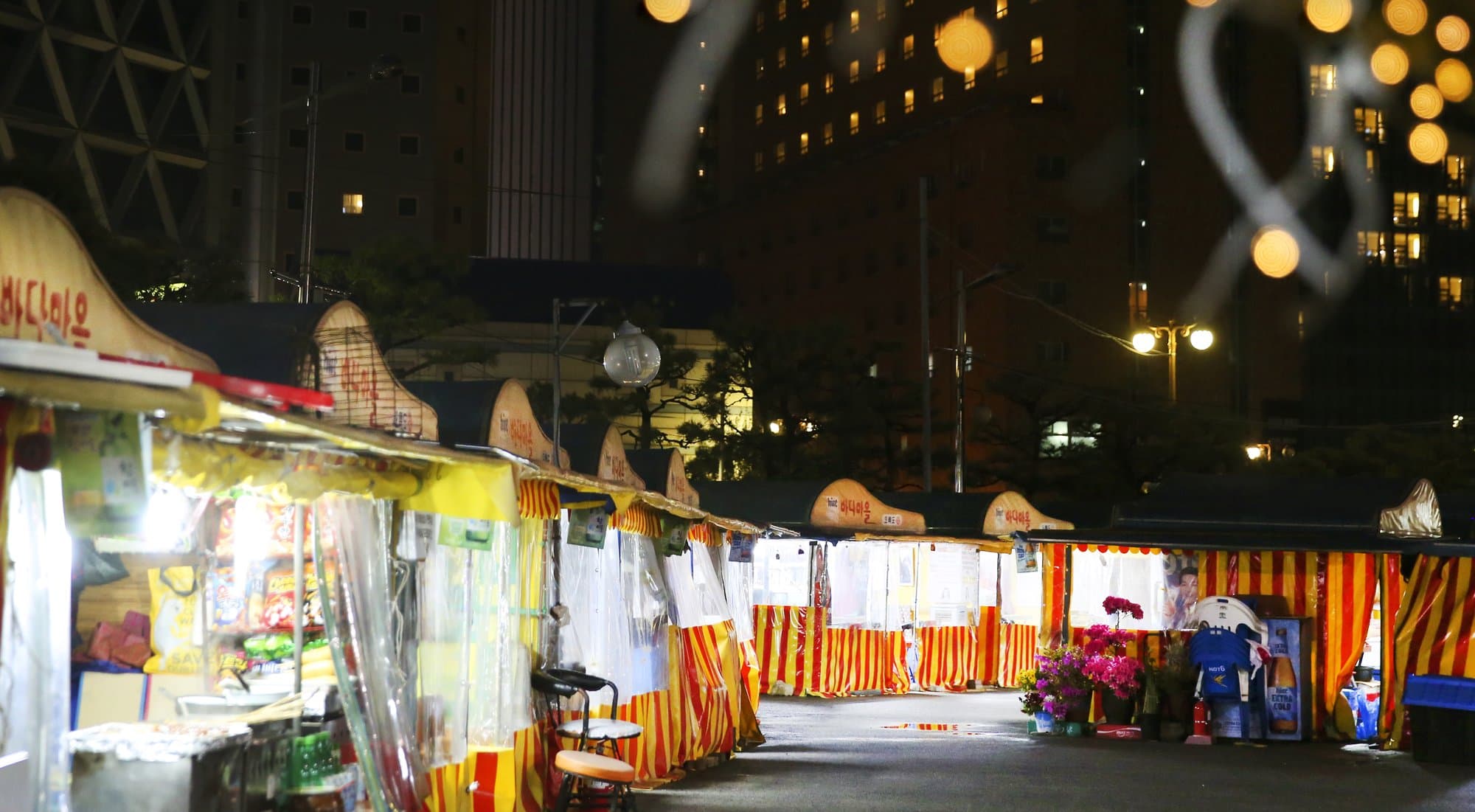
Photo by Busan Metropolitan City. Licensed under KOGL Type 1. Cropped and resized for web.
A row of pojangmacha on a Busan street tells you what it sells before you are close enough to smell it. Striped canvas, plastic sheeting against the wind, and a small lit board over each entrance carrying a few Hangul characters. That board is the menu, compressed to a word.
Korean restaurants do this nearly everywhere, and reading it is the most useful trick a visitor can pick up. A shop puts 국밥 or 곱창 or 포차 on the awning and treats it as the whole introduction. You walk in already knowing what dinner is. The printed menu mostly settles sizes, spice, and a few close cousins.
Boards that just say “Korean” in an American strip mall often try to cover everything at once: barbecue, stews, cold noodles, fried chicken, a page of pancakes. Older shops, in Korea and in a long-settled Koreatown, tend to be narrower than that. A soup house, a noodle house, a trotter house, and a drinking tent keep different hours and different pans. Learn a dozen words and the strip stops being a wall of characters.
Soup and stew words
국밥, gukbap (GOOK-bap), is the umbrella. Soup and rice, sometimes in one bowl, sometimes side by side. The word in front names the meat. 돼지국밥, dwaeji gukbap, is Busan’s pork version, usually served deliberately underseasoned so you finish it yourself with salt, fermented shrimp, and scallion. Half the pleasure is that last minute of adjustment.
설렁탕, seolleongtang (sul-LUNG-tang), is Seoul’s milky ox-bone bowl, simmered until the broth goes opaque and faintly sweet. It arrives nearly blank, and the salt and pepper on the table are part of the recipe. Imun Seolnongtang has been ladling it since about 1904, which the Seoul city government accepts as making it the oldest restaurant in town. 곰탕, gomtang (GOME-tang), is the clearer cousin, beef broth without the cloudiness. When a window advertises both, ask which one the kitchen would rather serve you.
Three more turn up constantly. 해장국, haejangguk (hay-JANG-gook), is hangover soup, deep and restorative, and a fair sign the room keeps late or very early hours. 순댓국, sundaeguk (SOON-dae-gook), floats slices of blood sausage in pork broth. 감자탕, gamjatang (GAM-ja-tang), is the big shared pot of spicy pork backbone and potato, built for a table and a long sit.
Noodle words
냉면, naengmyeon (NENG-myun), is cold noodles, and the split is usually posted right there on the glass. 물냉면 comes in chilled broth. 비빔냉면 comes mixed with a spicy sauce. Pyongyang-style rooms lean on buckwheat and a restrained broth that rewards paying attention. Hamhung-style rooms use chewier starch noodles and a hotter sauce, sometimes with raw fish. Both bowls came south with refugees and spread nationwide after the Korean War, which is why a single Los Angeles block can advertise 평양 and 함흥 at the same time.
칼국수, kalguksu (KAL-gook-soo), is knife-cut wheat noodles in hot soup, the lunch that fogs a window in January. 막국수, makguksu (MAK-gook-soo), is buckwheat again, tied to Gangwon province, served cold in broth or tossed with sauce. When a noodle word is the only word on the sign, that bowl is what the kitchen has practiced.
Meat and offal words
곱창, gopchang (GOP-chang), is grilled beef small intestine: chewy, rich, and almost always a soju night. 대창 and 막창 are neighboring cuts, one fattier and one firmer, and a mixed plate is the easy way to meet all three. 족발, jokbal (JOK-bal), is pig trotters braised in soy and spices, then sliced. 보쌈, bossam (BO-ssam), is boiled pork belly built for wrapping in lettuce with salted shrimp and fresh kimchi. Those two often share a late block, since both arrive already sliced and neither asks you to run a grill.
삼겹살, samgyeopsal (SAM-gyup-sal), is pork belly you cook at the table yourself. 갈비, galbi (GAL-bee), is ribs, usually marinated, pork or beef as the sign specifies. 고깃집, gogitjip (GO-gee-jeep), simply means meat house, so read the smaller word beside it to learn whether you are in a belly room or a rib room. 닭갈비, dakgalbi (DAK-gal-bee), is spicy chicken stir-fried on a wide hot plate, the dish Chuncheon is known for. Let it catch and darken at the edges before anyone starts talking about adding cheese or noodles.
Drinking-house words
포장마차, pojangmacha, shortens to 포차, pocha (PO-cha). It started as a covered cart and now also names indoor rooms that keep the tent’s mood: soju, beer, and anju, the dishes that exist to be eaten beside a drink. That sign is promising a night of shared plates and conversation. 호프, written hopeu and said closer to hof (HOFF), is a beer pub, usually with fried chicken. 분식, bunsik (BOON-shik), is the snack shop where tteokbokki, gimbap, and ramyeon come out fast and cheap. 한정식, hanjeongsik (HAN-jung-shik), runs the opposite way, a set course of many dishes arriving at once. Look for the per-person price near the door before you sit, because that word promises a spread rather than a specialty.
Regional clues on the same sign
A place name in the sign is usually a style note. 부산 beside 국밥 points to the pork bowl. 춘천 beside 닭갈비 means the stir-fried chicken plate rather than grilled ribs. 평양 and 함흥 sort the cold noodles into buckwheat or starch. And 집, jip, means house, which is why so many signs end that way: 국밥집, 곱창집, 냉면집. Soup house. Intestine house. Cold noodle house.
None of this requires good pronunciation. Say the word quietly, or point at it; the kitchen will hear the dish. What changes is smaller and better than fluency. A row of lit signs stops being decoration and starts telling you where dinner is.