
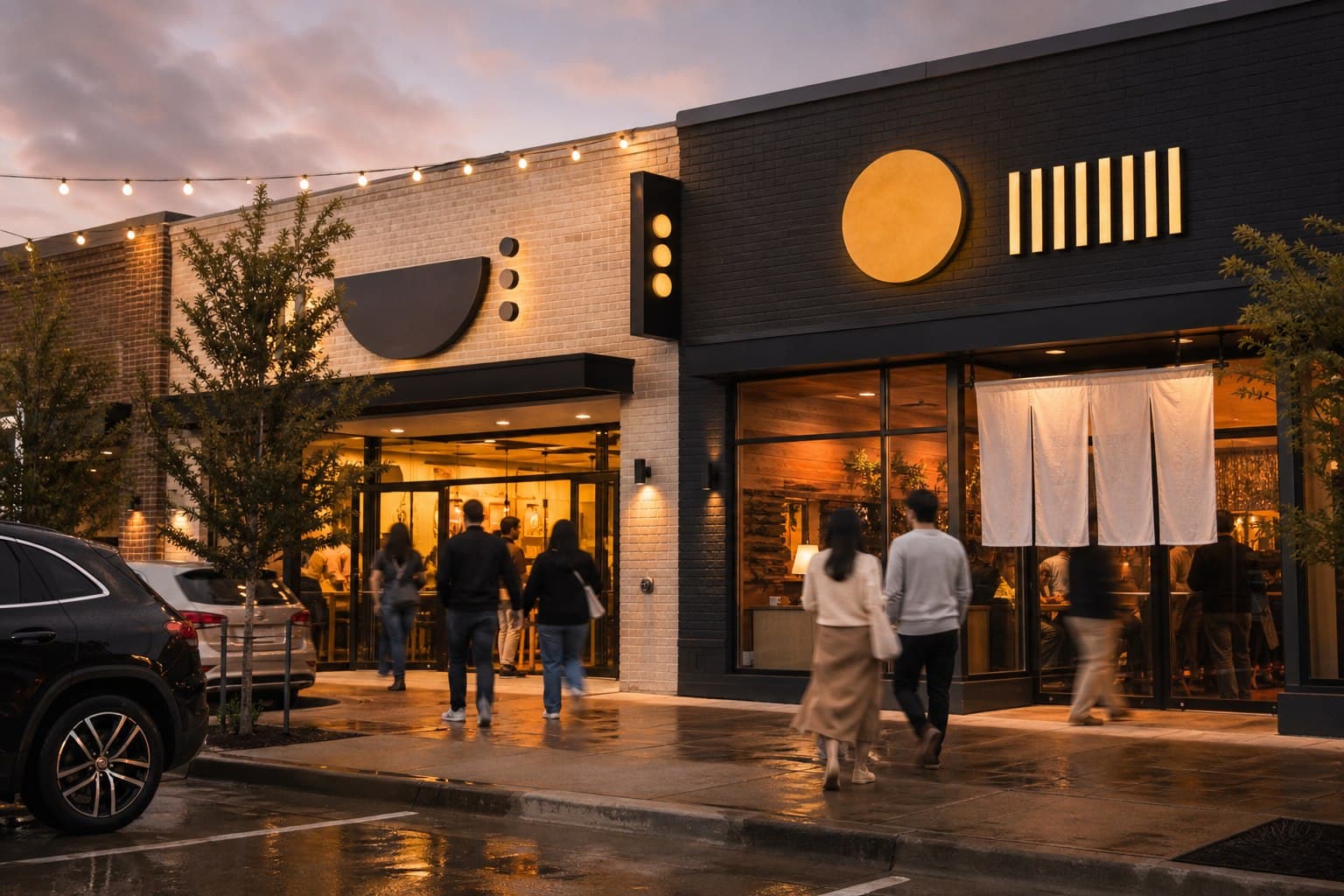
Photo by East Table. Licensed under Editorial. Generated street scene without brand marks; resized for web.
Bonchon Changed Hands and Sushiro Took Times Square. The Same Math Drives Both.
Home markets are full, and a plate of belt sushi sells for more than three times as much in America as it does in Japan. That gap, not a sudden national appetite for gochujang, is paying for the expansion.
August 19, 2026
At Eighth Avenue and West 42nd Street, next door to the Port Authority Bus Terminal, a three-floor sushi restaurant is going in. When it opens this fall it will be the first American location of Sushiro, the chain that has topped Japan’s conveyor-belt sushi industry in annual sales for fourteen straight years and now runs 948 restaurants around the world. Two floors of belt and roughly 150 seats, private rooms in the basement, more than a hundred items on the menu.
On August 13, on the Korean side of the same story, Bonchon agreed to change owners. The fried chicken chain, founded in Busan in 2002 and open in the United States since a 2006 debut in New York, is being bought from the Korean private equity firm VIG Partners and the Seo family by two buyers who split the world map between them. Minor Food, the Bangkok group that has run Bonchon as master franchisee in Thailand for years, takes everything outside the Americas. Serruya Private Equity, the Toronto firm behind Pinkberry and STK Steakhouse, takes the roughly 150 American restaurants and the job of multiplying them. The deal is expected to close by the end of August.
Set those two events side by side and a pattern appears that has surprisingly little to do with how much Americans have come to like Korean and Japanese food. The chains are running out of room at home.
Hiroyuki Okamoto, who handles public and investor relations for Kura Sushi, put it plainly to the Asahi Shimbun: with Japan’s domestic market shrinking as the population declines, the company has no choice but to go abroad if it wants to keep growing. Hajime Uba, who runs Kura’s American operations, was blunter still in an interview this summer. “Growth in Asia has reached a ceiling unless you can expand into China,” he said. “That’s why many Japanese restaurants are looking to North America.” Korean operators face a version of the same problem. The number of fried chicken outlets in Korea has been shrinking by roughly two percent a year, which is what a saturated category looks like from the inside.
Then there is the arithmetic, which press releases tend to leave out. A plate of belt sushi at Kura in the United States averages about $3.80. The same plate in Japan runs ¥120 to ¥150. Cheap sushi is a punishing business to run anywhere, and the big Japanese chains spend around 43 percent of sales on food against roughly 35 percent at an ordinary restaurant in Japan, so the model survives on volume and precision rather than markup. Move that same machinery to a market that pays triple and the margins look like a different business. Sushiro earns about 12 percent operating margin abroad against 6.8 percent at home.
What is crossing the Pacific, in other words, is less a cuisine than an operating system, and it is being pointed at the customers who pay the most for it.
On the Korean side the buildout is further along than most diners realize, and it is bakeries rather than restaurants leading it. Paris Baguette, owned by the Seoul conglomerate SPC Group, passed 300 North American cafés this year across more than 30 states, with roughly 600 more in active development and a stated goal of 1,000 by 2030. Its 300th store opened inside Philadelphia International Airport, the brand’s first airport café on the continent. Tous Les Jours, the rival bakery from CJ Foodville that arrived here back in 2004, reached 205 North American stores in June and has now turned a profit in the United States for eight consecutive years, with more than 90 percent of its stores franchised. Fried chicken is close behind. bb.q Chicken, run by Genesis BBQ, has gone from 125 American stores in 2023 to more than 300 across 33 states, with over a hundred signed locations still waiting to open.
The most telling sign that these are long commitments is not the store counts but the concrete. Paris Baguette broke ground on a $200 million, 267,000-square-foot bakery plant in Burleson, Texas, and CJ Foodville began running a plant in Gainesville, Georgia at the end of last year with capacity for more than 100 million frozen doughs and cakes a year. A company can walk away from a lease in a way it cannot walk away from a factory that size.
Where the restaurants land has changed too. The early American map for both cuisines ran through Koreatowns and Japantowns and the college towns beside them. bb.q now reports that some of its strongest markets are in Oklahoma, Kansas, and Tennessee, places where the Asian population sits below five percent and where a Korean chicken shop is often the first Korean anything in the trade area. Its first American drive-through opened in Franklin, New Jersey in December 2025, which is about as suburban a format as the category has attempted. Franchisees have been taking over second-generation restaurant spaces, which can cut the cost of building a store by half. Marugame Udon, meanwhile, is hunting 2,000 to 2,400 square feet across six Puget Sound cities.
Sushiro’s Times Square lease is the loud exception, and it was meant to be. “Times Square is the very heart of New York City,” said Hiromitsu Kato, the executive overseeing overseas business at parent company Food & Life. “It is a declaration of our intention to commit to expanding our stores in the United States.” The flagship makes the announcement, and the strip malls do the actual growing.
The menus bend on arrival, though less than you might expect. Marugame’s American stores sell the Sanuki-style bowls the chain is known for alongside a tonkotsu udon, a curry nikutama, and chicken katsu curry around $11.95, and the new Rowland Heights store opened this month with a malatang udon built for the Sichuan-leaning palates of that particular San Gabriel Valley corner. Kura’s American belts carry premium American beef nigiri and seared beef with yakiniku sauce next to the tuna and tamago.
The more interesting adaptation is the check. Some of Marugame’s West Coast restaurants rank among the ten highest-grossing locations in Toridoll’s entire global system, with spending per customer approaching ¥3,000, more than triple the Japanese average. American diners treat a bowl of udon as a full meal out rather than a quick lunch, and they order accordingly. That is the number that has Toridoll founder Takaya Awata talking about udon becoming a global fast-food category alongside burgers, chicken, and pizza.
The gap between what gets announced and what actually opens can be wide. Pepper Lunch, the Japanese teppanyaki chain, was publicly aiming at 100 American locations by 2026 and has somewhere between 10 and 12 operating, after four closures since May and the end of its Canadian business on May 31. Its chief executive has since revised the target to 23 by year end, with 26 leases signed. Kyochon, one of Korea’s largest chicken franchises at home, has been in the United States since 2007 and operates five American units.
Even the disciplined operators lose time. Kura Sushi, which is publicly traded and reports its openings quarterly, told investors in July that unexpected permitting and fire-inspection requirements had delayed four restaurants, costing it about six restaurant-months of sales and trimming roughly $3 million from its revenue guidance for the year. One North Carolina location was asked for a third-party conveyor belt inspection that had never come up in the previous 93 openings. A signed development agreement tells you what a company intends, and the permit office tells you when any of it will actually happen.
The question independents keep getting asked is whether this wave is coming for them, and the honest answer resists a clean headline. The pressure is real in specific places. Franchise-industry analysis of the category notes that three competing Korean fried chicken concepts within two miles has become a plausible scenario in a large metro, which was not true five years ago. But causation is easy to get wrong. Stone Bowl, a Korean and Japanese restaurant in the Oakley neighborhood of Cincinnati, closed on August 16 after twelve years, in a stretch where a CM Chicken and a CAVA both opened nearby. Owners Young Park and Misook Gwon said the decision was about family rather than money; they had been living apart for four years because of a job relocation and wanted to be in one place again.
What has genuinely shifted is discovery. Delivery apps now hand a ten-seat shop the same shelf space that once belonged to whoever could afford billboards, which cuts against the chains as often as it helps them. Jihan Lee, who trained under Masa Takayama and runs the West Village hand-roll restaurant Nami Nori, opened a small gimbap shop called TBD Gimbap next door in March and has turned down most influencer requests since, on the grounds that he does not want a three-hour line outside a counter built for quick rolls. “If I put something out that isn’t thoughtful,” he said, “people aren’t just judging my shop, they’re forming an impression of the cuisine.”
For anyone who would rather eat than read balance sheets, the confirmed list is short and specific. Marugame’s 23rd American restaurant has been open in Rowland Heights since August 7. Kura opened in Tulsa, in Sunset Valley outside Austin, and in Charlotte over the summer. Jinya Ramen Bar reached New York in January with a Long Island store and added Hackensack in April. Sushiro’s Times Square room is still unbuilt, with no day announced beyond this fall.
Everything else on the list is a lease, a target, or a number in a deck.