
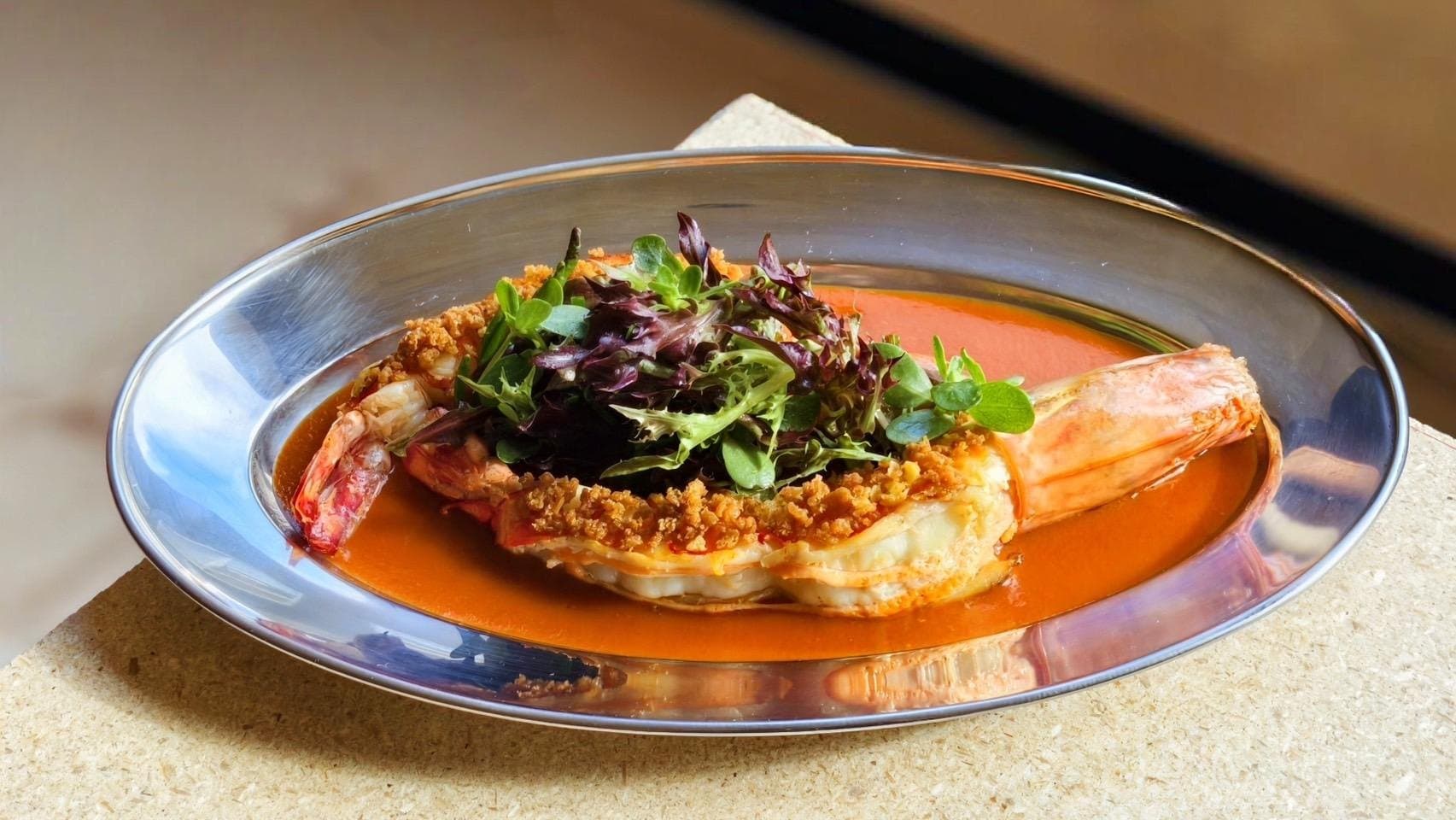
Photo by Saam. Licensed under Brand. Courtesy Saam; restaurant-provided dish photo; resized for web.
At Saam, Chef Ton Translated Bangkok Fine Dining Into Shareable Plates
The SoMa room skips the Le Du and Nusara tasting format. Scratch curries, California produce, and an à la carte menu may be the version of Thai fine dining that travels.
August 20, 2026
Saam has been open on Brannan Street for nearly a month, long enough for the shape of the menu to be clear. Plates arrive meant to pass, rice sits in the middle of the table, and nobody asks whether you want the chile dialed back. For Thitid “Ton” Tassanakajohn, whose name was made on two of Bangkok’s most decorated tasting menus, that is a deliberate change of format.
Saam, at 415 Brannan in SoMa, is Ton’s first restaurant in the United States. The name means “three” in Thai, for Ton and his two Bay Area partners, Tee Atthapon and Ty Choosuwan, and for the spicy, sour, and salty spine the kitchen wants on the table. About sixty seats sit upstairs in the former Sun and Moon space near Oracle Park, among wood walls and clay vessels brought over from Thailand. Reservations run through Resy.
Ton’s Bangkok résumé is the reason the opening drew national attention in the first place. He left economics at Chulalongkorn for the Culinary Institute of America, cooked in New York at Eleven Madison Park, The Modern, and Jean-Georges, then went home and opened Le Du in 2013. The name comes from ฤดู, the Thai word for season. Le Du earned a Michelin star and, in 2023, the No. 1 spot on Asia’s 50 Best Restaurants for a contemporary tasting menu built on Thai produce. Nusara, opened in 2020 with his brother Chaisiri “Tam” Tassanakajohn and named for their grandmother, is the intimate tasting room that now sits at No. 5 on Asia’s 50 Best and holds a Michelin star of its own. Both rooms run on ceremony, a fixed sequence at a fixed price, booked weeks out. Saam asks for none of that.
The ownership structure is part of that difference. Atthapon, chef-owner of Kan Kiin in Daly City and Song Wat on Divisadero, is general manager. Choosuwan, who cooked at Prospect and Boulevard, is chef de cuisine. Ton holds the executive chef title and still lives in Thailand. Local reporting describes a menu developed partly by text and photographs: Ton sent instructions from Bangkok, the Bay Area pair cooked and shot the plates, and notes went back across the Pacific. He flew in for the opening stretch. The day-to-day kitchen, by design, belongs to people who already know how San Francisco eats.
Choosuwan has described the service the way Thai households cook when company is over. You pass the soup, the vegetables, the rice, the meats. That is how the food actually reaches the table here, and it is the clearest break from the rooms Ton runs at home.
The translation shows up most clearly in the pastes and the produce. Ton has said that years of visiting San Francisco with his wife convinced him the city could support the cooking he wanted, and that New York would make the aromatics harder. Fresh lemongrass and coriander root are easier to buy in California than on the East Coast, he told Eater, and Los Angeles weather felt too much like Bangkok. The kitchen’s stated rule is simple and expensive: curry pastes pounded daily from scratch with local ingredients, no cans. That is Bangkok fine-dining language without the tasting-menu scaffolding that usually carries it.
On the plate, the substitutions are California ingredients put to Thai work. Som tum arrives as a small mound of diced local peaches with marinated raw shrimp instead of green papaya. Thin-sliced duck from Root Down Farm goes into a pad ped ped built on shrimp, fingerroot, makrut lime, and young coconut. Manila clams sit in gaeng kua. A dry-style seafood khao soi, thick wheat noodles under shrimp, squid, and mussels, stands in for the pad Thai Americans still expect. Large formats include a salt-crusted branzino with pla ra and a peanut seafood sauce for wrapping, and a tiger prawn with shrimp paste and fava beans that lands near seventy dollars on reported menus. Gaeng kua clams have been listed around twenty-nine. Those are fine-dining numbers, charged one plate at a time.
San Francisco already had a serious Thai map before Brannan Street got another address. Kin Khao, from chef Pim Techamuanvivit, took a Michelin star in 2015 as the city’s first Thai restaurant to do so; Nari followed in the same orbit. Those rooms proved Thai cooking could hold fine-dining attention here. Newer rooms like Nudi Blue, Tur, and Glom Thai have leaned casual and specific, treating Thai food as a night out that needs no guided tasting. Saam sits closer to that shareable lane than to Nusara’s ten-seat choreography, even as the technique and the paste work come from Ton’s starred kitchens.
Importing an intact Bangkok tasting menu would have been the easier story to sell. It also would have asked American diners to accept the most expensive, least familiar format first. An à la carte room lets the cooking travel the way Thai meals already travel: one strong curry, one seafood plate, rice, a salad that hits sour and heat, another bottle if the table is still hungry. Anajak in Los Angeles, Kalaya in Philadelphia, and Bangkok Supper Club in New York all built serious reputations on menus diners order from. Saam is Ton’s version of that bet, built with partners who can hold the kitchen when he is back in Silom.
Whether Saam becomes the restaurant that pulls modern Thai fine dining into a wider American mainstream is a longer question than one opening month can answer. A résumé fills Resy for a few weeks; the format has to hold the year after that. What the opening has settled is how the cooking crossed. Ton sent the parts of Le Du and Nusara that survive an American night out: the scratch pastes, the seafood, the California produce, the heat set where the kitchen wants it.
The tasting menu stayed in Bangkok. Anyone who wants that version still has to fly.