
Why Stir-Fry Works
High heat, small pieces, and constant motion: what chao is doing in the pan, and why it fits a weeknight when one person cooks.
Updated July 24, 2026
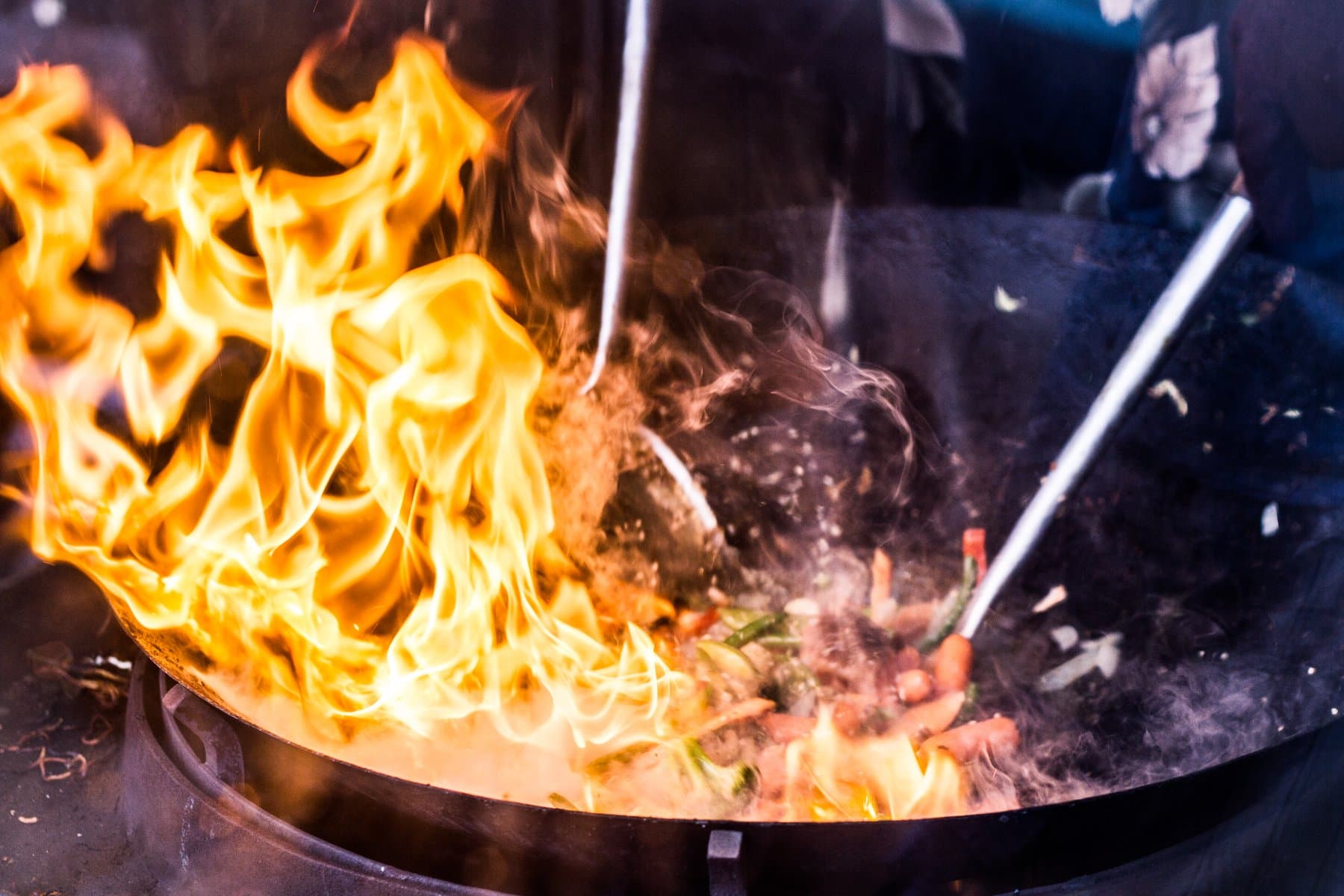
Photo by Nick Webster. Licensed under CC BY 2.0. Resized for web. Photographed at the Minnesota State Fair.
A good stir-fry tastes awake: vegetables still bright, meat browned at the edges, sauce clinging instead of pooling. A bad one tastes like a wet sauté that never quite got hot. The difference is not a secret sauce packet. It is what the method is designed to do.
In 1945, Buwei Yang Chao needed an English word for Chinese chǎo (炒). In How to Cook and Eat in Chinese she called it stir-fry: big fire, shallow fat, continual stirring, quick frying of cut-up food with wet seasoning. She also called it blitz-cooking. That definition still holds. Stir-fry is a heat-and-motion system. It is not a party format where everyone cooks at the table. One person stands at the pan. Everyone else eats.
Heat that outruns water
Food is mostly water. When pieces hit a merely warm pan, that water floods the surface and the temperature collapses toward a simmer. You get steaming and stewing. Stir-frying tries to stay ahead of that flood.
Cut food small so the interior finishes in the short time the exterior can handle high heat. Keep the pan hot and the food moving so moisture leaves as vapor instead of collecting as liquid. America’s Test Kitchen describes the geometry plainly: the wok’s contact point is a sear zone; the curved walls trap a steam layer that helps cook pieces through as they tumble. Motion is not theater. It is how each face of a piece gets a turn on the hot metal without sitting long enough to burn.
When water gets out of the way, flavors concentrate and Maillard browning can start. That is the savory crust people chase. Crowd the pan, and you donate your heat to boiling the juices you just released.
What chefs mean by wok hei
Cantonese cooks talk about wok hei, often rendered as the breath of the wok, a phrase Grace Young helped lodge in English. It is not one molecule. Writers and chefs point to blistering browning, the aroma of oil pushed to the edge of smoke, and the way tossing throws tiny droplets into hot air where they can singe. Restaurant wok burners can put out tens or hundreds of thousands of BTUs. A typical home burner sits closer to ten or twenty thousand.
Physicists at Georgia Tech filmed professional chefs tossing fried rice and found a steady rhythm near 2.7 tosses per second. The food leaves the metal briefly, which is how it can take extreme heat without turning to ash. That is restaurant physics. At home, the useful lesson is smaller: preheat until the pan is honestly hot, cook in batches that do not drown the surface, and keep things moving. You may not get full restaurant breath. You can still get browning and snap instead of soup.
An old answer to expensive fuel
Chao as cooking appears early in Chinese sources, including a sixth-century egg method in the Qimin Yaoshu, then more often in Song-dynasty recipes as vegetable oil entered the kitchen. Historians note that the technique became more common in the late Ming, when wood and charcoal near cities grew costly and cooks needed food that finished fast. Speed was thrift. Boiling and steaming never disappeared. Stir-fry was one tool among many, not the whole cuisine.
That history rhymes with a Tuesday night. The expensive resource now is attention. Once the knife work and sauce are done, the active time at the stove can be a few fierce minutes while rice finishes beside you. Meat can season a pan of vegetables instead of owning the plate. Grace Young has long argued that this economy of time, fuel, and ingredients is part of why the method traveled so well with Chinese cooks abroad.
Why mise is the real drama
Because the heat window is short, stir-fry punishes improvisation after the oil goes in. Garlic burns while you hunt for soy sauce. The pan cools while you finish chopping broccoli. The interesting discipline is upstream: pieces cut to size, sauce mixed, aromatics ready, cook standing where the spatula is.
That is also why this is a household dinner method rather than a hosting format. Hot pot invites guests into the heat. Stir-fry asks one cook to finish the heat alone, then bring the plate out. When it works, the table gets a hot dish that still tastes like itself: crisp where it should be crisp, browned where it should be browned, and done before the evening turns into a project.