
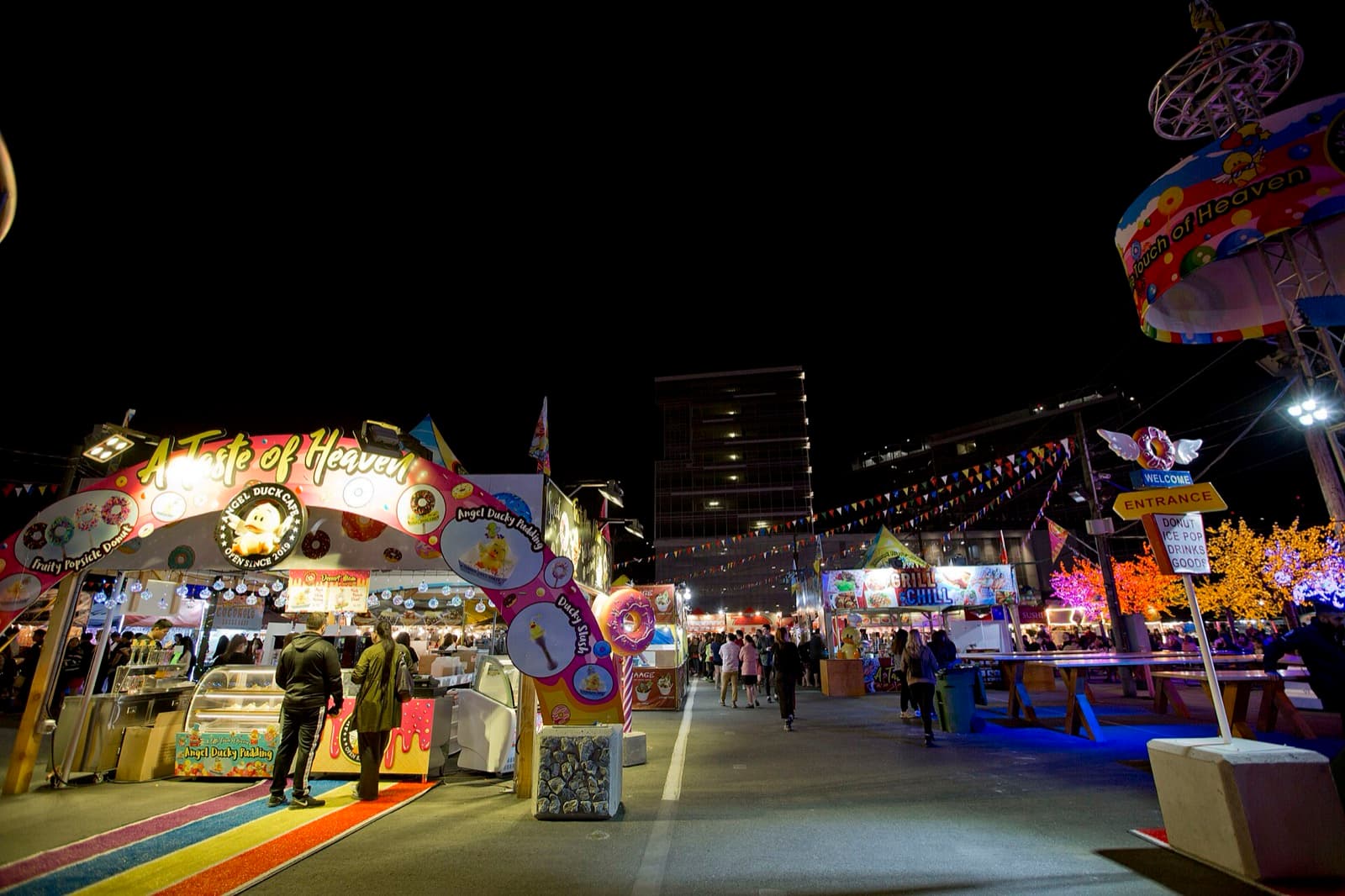
Photo by GoToVan. Licensed under CC BY 2.0. Resized for web
Night Markets, Abroad and at Home
The format travels, but the best versions still depend on density, price, and local appetite.
April 30, 2025
Picture a North American summer night market: string lights, a ticket wristband, and a sixteen-dollar plate that ends the evening after two stops. The photos look right. The math often does not.
What makes night markets feel generous in Taiwan or along a Malaysian pasar malam is not neon alone. It is density of stalls, snack-sized prices, and fast enough turnover that curiosity stays cheap. Many diaspora festivals and fairground markets borrow the look. Fewer keep the economics that let you graze.
What the originals optimize
A working night market packs many stalls into a short walk. Duplicate concepts compete. Lines act as soft signals. Portions stay in xiaochi territory: small enough to share, walk, and return for something else. Academic and tourism research on Taiwanese night markets keeps returning to novelty, eating out, and renao, the crowded heat and noise that feel like part of the draw rather than a planning failure.
Price matters as much as atmosphere. Guide consensus in Taiwan still puts many snacks in a low single-digit U.S. dollar band per item, which is what lets two people try six or eight things without treating each stop like dinner. Malaysia's rotating pasar malam adds another model: neighborhood evening markets that mix food with everyday goods, closer to a local night market than a ticketed festival.
Bangkok, Saigon, and Singapore have related evening formats, from purpose-built food markets to hawker nights and seasonal bazaars. They are cousins, not clones. The useful lesson is the shared constraints: density, snack pacing, and prices that invite another stop.
How North America borrows the format
Diaspora night markets in Canada and the United States often begin as places to hold onto food memory. 626 Night Market in Southern California grew from Taiwanese inspiration into multi-day fairground events with day tickets and a mix of nostalgia snacks and fusion spectacle. Organizer interviews have long noted that U.S. health rules, zoning, and costs pushed an American-style evolution rather than a street-cart copy of Shilin.
Richmond Night Market in British Columbia sells scale: weekend summer fairgrounds, general admission, food plus retail and attractions, with tourism messaging that pushes under-ten-dollar food during Happy Hour windows. Seattle's Chinatown-International District Night Market is a freer neighborhood street festival, closer to a community gathering, and also more fragile when sponsors disappear. Houston and Toronto versions often land as festival hybrids, sometimes free outdoors, sometimes ticketed indoors or on waterfront stages.
Queens Night Market is the clearest documented North American attempt to protect grazing economics. Entry has mostly stayed low-friction, and a roughly six-dollar dish cap has worked as a social equalizer for years. Reporting in 2026 framed that season as the final year of the cap, which is a reminder that even careful price rules are policy choices, not permanent weather.
What has to survive the move
- Density: enough stalls in a short walk that choice feels real
- Price: snack units cheap enough for a third and fourth stop
- Pace: small portions and fast turnover, not entrée math
- Appetite: neighborhood or repeat visitors, not only one-night tourists
Where grazing breaks
Gate tickets stack with food spend. Paying before the first skewer changes how freely people wander. High booth fees, insurance, permits, and labor raise the floor under every plate. When a snack is sized and priced like a restaurant appetizer, visitors stop after two vendors, and the loop dies.
Sparse lots make the same mistake in space. A dozen trucks in a vast parking field photograph as a night market and feel like a food-truck rally. Sit-down wait service and long cook times do similar damage to turnover. Food halls and walk-around markets can recreate density of choice, but fixed rents and larger average checks often push them toward different economics.
What still works, when it works, is stubbornly simple: short menus, portions you can share, prices that invite another bite, and walking room that stays lively. Fusion and themes can be fun entertainment. They are not the definition of the format.
At home, only the transferable parts
Living-room night markets in magazine roundups usually mean stations, paper trays, skewers, and movement between folding tables. That is enough. Small portions and several stops travel. String-light cosplay does not make a kitchen into a street market, and it does not need to.
Night market energy is less a lighting package than a set of constraints. When density, price, and local appetite line up, the format feels generous. When they do not, you get a festival that borrowed the name. The field test is simple: after the first bite, can you still afford to be curious?