
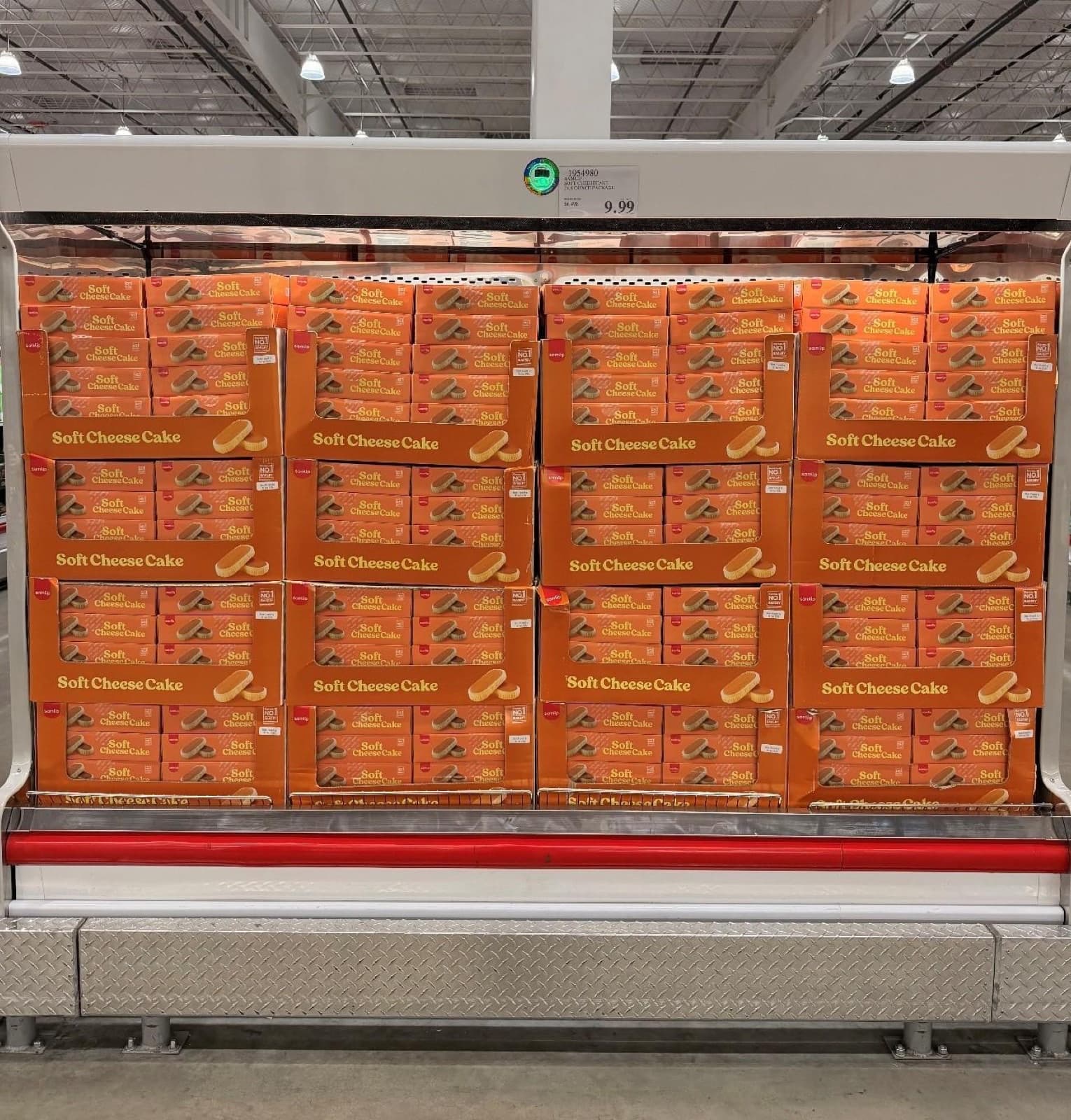
Photo by SPC Group / Samlip. Licensed under Press. Courtesy SPC Group; Costco San Diego soft-cheesecake display, March 2026. Cropped and resized for web.
Why Soft Asian Cheesecake Keeps Winning Over Dense New York Cake
At Costco, Samlip’s soft Korean cheese cakes keep selling out. The fluffy style remade German and American cheese cake for snack boxes, bakery lines, and a much lighter forkful.
October 2, 2026
In a Costco fridge in San Diego, the orange cartons stack the way soda cans do. Soft Cheese Cake. Product of Korea. Ten individually wrapped ovals for about ten dollars. People film the case. Plenty of carts leave with two boxes.
SPC Samlip says this was the first Korean bakery item into U.S. Costco when West Coast warehouses got it in late September 2025. The opening shipment of about 560,000 packs sold out in three weeks, the company told Korean business reporters in February 2026, at roughly 27,000 packs a day. Then the cake jumped to about 300 warehouses, and a second wave ran into the millions. By spring, Samlip’s international sales director, Lee Jin, was telling The Korea Times that Soft Cheesecake was topping categories in some states. He thought it could become “the next Twinkies” in America.
Sales talk aside, the crumb is the story. These cakes are soft and only lightly sweet. They taste closer to a steamed sponge with a little cream cheese than to the dense wedge that made Junior’s famous in Brooklyn. Shoppers keep restocking them. So why did a lighter East Asian cheese cake fit the warehouse club better than the dessert New York built its name on?
What dense cake actually is
New York–style cheesecake starts with a lot of cream cheese. Upstate dairymen began making the stuff in the late nineteenth century. By the 1930s, Manhattan restaurants were baking stabilized cream cheese into a thick, silky cake that could sit on a graham or pastry crust. Food histories usually give early credit to Arnold Reuben’s restaurants and to Lindy’s. Junior’s opened in Brooklyn in 1950 under Harry Rosen, with baker Eigel Peterson on the recipe, and became the public face of the dense slice: firm, faintly tangy, often finished with fruit.
When The New York Times wrote about that style in 2025, it kept coming back to Philadelphia-brand cream cheese as the ingredient that made the city version possible. You beat a lot of cheese. You add whole eggs or extra yolks so it sets. You bake for structure. One forkful can feel like the whole dessert course.
Soft Asian cheesecake starts somewhere else. Japanese bakers call the soufflé style sufure chīzu kēki; English menus say cotton or jiggly. You melt or soften a smaller amount of cream cheese with milk and butter, whip the egg whites into a meringue, fold carefully, and bake the pan in a water bath so the batter rises like chiffon. Technique writers at Serious Eats keep pointing to the same trade: less cheese, more air, and a little starch so the soufflé does not fall in on itself. Warm from the oven, it wobbles. Chilled, it eats like a light sponge with a milky finish.
Same grocery word. Very different cake.
How Japan remade cheese cake
Cheese cake showed up in a Japanese cookbook as early as 1873, but cream cheese did not feel ordinary until after the war, once American kitchens and home refrigerators were part of daily life. In 1969, Tomotaro Kuzuno of Kobe’s Morozoff, a Western pastry house, ate käsekuchen, a German cheese cake, in Berlin and came home wanting a Japanese version. Morozoff launched its Denmark Cream Cheese Cake that year with specially ordered Danish cream cheese and a milder finish. Company histories and Japanese food magazines credit that cake with helping set off a 1970s boom, especially once Philadelphia cream cheese reached Japan too.
Morozoff’s famous cake is denser than the jiggly clips that travel online. The soufflé style grew beside it. Japanese Western pastry, or yōgashi, has long chased fuwa-fuwa, the word people use for that fluffy bounce you also get in soufflé pancakes and soft shortcake. Sugar stays quieter. Cheese becomes a soft note in the background.
Osaka’s Uncle Rikuro made the soft cake a daily stop. In June 1984 the shop started selling freshly baked cheesecake in small batches, each stamped with Rikuro Nishimura’s cartoon face. Nishimura liked to say sweets had to be soft. Tourists still line up in Namba for a warm round that tastes mild and eggy, with syrup-soaked raisins at the bottom.
Uncle Tetsu took the same idea abroad. Tetsushi Mizokami founded the chain in Hakata, then opened the first North American shop in Toronto in 2015. Two-hour lines formed for a six-inch cake. Honolulu followed in 2016 with Panda Restaurant Group as partner, then Arcadia in California. A few ovens, warm boxes, a stamp on top. People waited for the texture.
Korea’s everyday soft cake, then the warehouse
Korean bakery-café chains put soft cheese cake in the fridge long before Costco did. Paris Baguette sells Soft Cheese Cake and a soufflé-style Heavenly Cheesecake. Tous Les Jours lists Souffle Cheese Cake on U.S. menus. Back in 2011, The Korea Times already noted how interchangeable those oblong, individually wrapped cakes looked in the case: cheese, mocha, sweet potato, about a thousand won, eaten as a snack more than as a plated dessert.
Samlip scaled that habit for the warehouse. The company describes Soft Cheesecake as a hybrid of Western baking and Eastern steaming, moist and a little chewy, with cream-cheese flavor that stays gentle. Flavors have included original, chocolate, banana, strawberry, sweet potato, and melon. Lee told The Korea Times people sometimes call it steamed cake because of that dual method. The cakes leave Busan for Los Angeles in about two weeks, longer for the East Coast, and they have a shorter shelf life than many American packaged sweets. That is a hard way to compete with Hostess. Volume has answered anyway. Samlip said overseas soft-cheesecake sales jumped after the Costco run, and the cakes were already selling from Vietnam to the Middle East.
Into October 2026, Parade and Costco-find accounts were still chasing restocks. The box behaves like a bakery snack with a membership card attached. One after school. One in a lunch bag. A fork is optional if you do not mind crumbs.
Why the soft one travels
Dense New York cake still owns the deli plate, the holiday slice, and any crust that wants fruit glaze. Soft Asian cake fits a different afternoon: something to share, something mild enough that people who find American cheesecake heavy after two bites will finish the piece. The meringue structure jiggles on camera. The sweetness sits closer to Korean and Japanese bakery norms than to a Junior’s wedge. The portions are already decided for you. Warehouse clubs love that math.
Dairy already shows up across East Asian bakery cases, corn cheese, and snack breads. Soft cheesecake belongs to that comfort with cheese. You get the flavor without the fork feeling like work.
One naming trap is worth a warning. The recent TikTok “Japanese cheesecake” made from Greek yogurt and cookies borrowed the label. That one is a fridge hack. The soufflé is the baked cake in this story.
Junior’s can keep the dense empire. Uncle Tetsu can keep the warm line. Out in the warehouse aisle, Samlip’s orange carton sits next to the rotisserie chickens and keeps disappearing. Soft Asian cheesecake found the jobs New York cake never needed to do, then followed those jobs into a Costco fridge.