
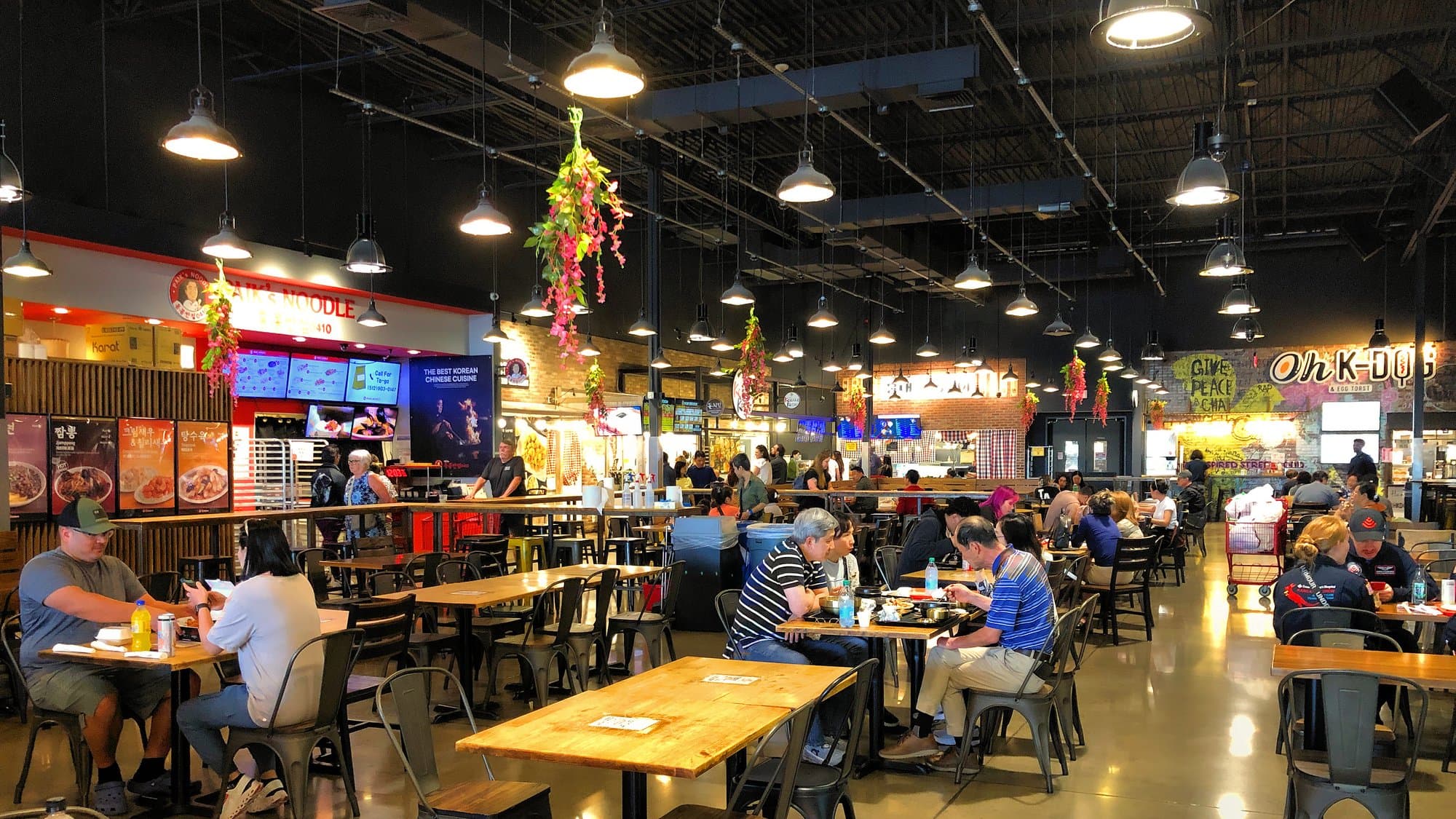
Photo by Larry D. Moore. Licensed under CC BY 4.0. H Mart Market Eatery, Austin, Texas, March 25, 2025. Resized for web.
Sugar Land’s Kroger Box Is Becoming an H Mart.
The city was already about 38 percent Asian, and a 99 Ranch is a few minutes away. Fort Bend’s Asian population has more than doubled since 2010. The building that’s changing is the old Kroger.
October 13, 2026
On Highway 6 in Sugar Land, H Mart is building a supermarket into a box that used to be a Kroger Signature and, after that, a Floor & Decor flooring store. The new store runs a little over 64,000 square feet, with a food hall of ten counters. A Texas licensing record put the interior work near $4.5 million and set the end of March as the target. March passed. The company says the opening is soon. A spokesperson told the Houston Chronicle there is still no date.
Sugar Land’s census page already describes the city. In 2020 it counted 111,026 people. Residents who are Asian alone and not Hispanic were 38.4 percent of them, just ahead of white residents who are not Hispanic. Community Impact, a suburban Houston news site, found that the city’s Asian population grew 54 percent from 2010 to 2020, while its share of the city moved from about 35 percent to about 38. The Houston Chronicle reported last year that a 99 Ranch and a Seafood City already sit a few minutes from this building.
The city’s share was already high, so it had less room to move. Fort Bend County, where Sugar Land sits, is a larger map. Community Impact, citing the 2020 census, put the county’s Asian share at 22.2 percent, the highest of any county in Texas, against 7.4 percent in neighboring Harris County. Rice University’s Kinder Institute, in a study released this January, put the growth in Fort Bend’s Asian population at 117 percent from 2010 to 2023. Daniel Potter, who co-directs the institute’s Houston Population Research Center, said more Asian residents live in Fort Bend today than lived in the entire state of Texas in 1980.
Statewide, the Texas Demographic Center counted non-Hispanic Asian residents at 948,426 in 2010 and 1,561,518 in 2020, a rise of 64.6 percent. That was about 15 percent of the people Texas added in those ten years. The race question changed between those counts, so the comparison is rougher than it looks. Kinder also counted the Houston region, Harris and Fort Bend plus Montgomery and Brazoria, over about forty years. Asian residents went from 1.8 percent of the area to 9.9 percent, more than 655,000 people.
Il Yeon Kwon opened the first H Mart in Woodside, Queens, in 1982, under the name Han Ah Reum, a Korean phrase for an armful of groceries. His children, Stacey and Brian Kwon, share the president’s title. The company counts 110 stores in 20 states. Progressive Grocer, the grocery trade magazine, ranked it No. 80 on its 2026 list of the country’s top grocers. Houston’s stores go back to 2008. Three are already open, in Asiatown, Spring Branch, and Katy Asian Town. Sugar Land would be the fourth, and the first in that city. The company already builds dining rooms inside its stores, including one in Austin.
For a long time, the H Mart run in Houston pointed at those existing stores, in neighborhoods that already had the restaurants. Sugar Land’s project puts the chain in a building that used to be the Kroger, on a road people already use for ordinary errands.
Fort Bend’s Asian communities come from more than one place. The Kinder study found people with roots in India the largest Asian ethnic group in the Houston region, more than 150,000, with large Chinese, Vietnamese, and Korean communities beside them. The food hall on the plans stays with East and Southeast Asian counters: Paik’s Noodle, a Korean-Chinese shop, the Vietnamese restaurant Cam On, the Japanese shop Kumo Katsu & Ramen, and the bakery Tous Les Jours. A Korean-founded grocer can take the old Kroger building and still be one stop among others.
Sugar Land had this population at the last census, and Asian grocers were already nearby. The change on Highway 6 is the building the Kroger left.