
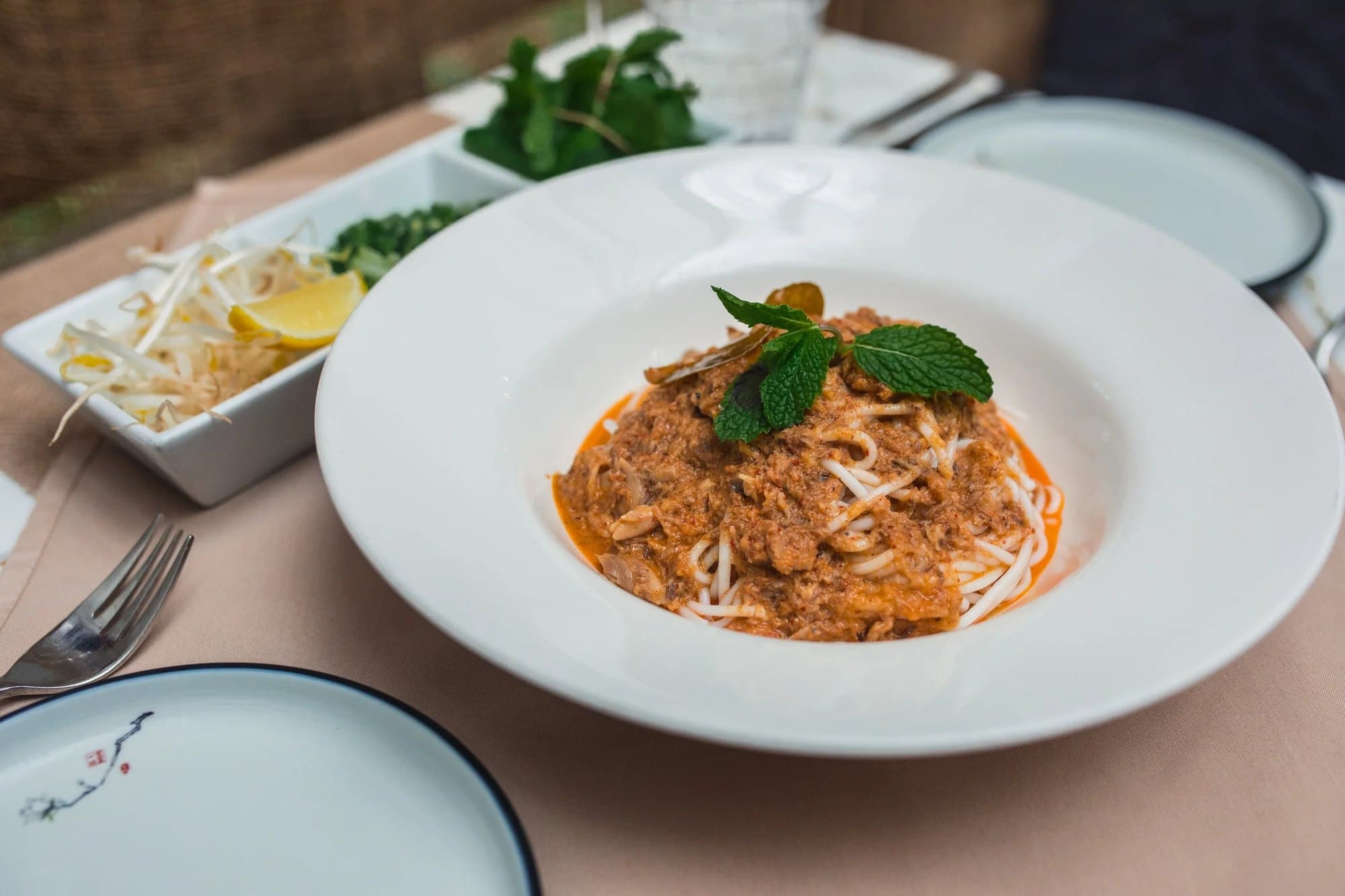
Photo by Bayon. Licensed under Brand. Courtesy Bayon; resized for web.
Bayon’s Closure Ends Chef Minh Truong’s 45-Year Restaurant Career
The Michelin Bib Gourmand Cambodian restaurant on the Upper East Side closed August 3 as Truong retired, taking a rare storehouse of Khmer cooking memory with it.
August 14, 2026
Bayon served its last meal on Monday, August 3. Chef Minh Truong and his wife, Mandy, who ran the dining room, closed the Cambodian restaurant at 408 East 64th Street so he could retire after what they called 45 years in New York restaurants. The room had held a Michelin Bib Gourmand, the guide’s badge for good cooking at a friendly price, in 2024 and 2025. The close is a retirement, not a collapse, though for a diaspora kitchen those can feel alike.
What disappears with a chef like Truong is not only a reservation book. It is the working memory of a kitchen: how prahok should taste in a lettuce wrap, how thick rice noodles take a fish curry, how a banana-leaf amok should set. New York has many Vietnamese and Thai rooms. Full Cambodian kitchens have been scarce for decades. When one closes because the cook is done, the city does not automatically grow a replacement.
Truong’s path is the memory bank. Born in Phnom Penh, he fled Cambodia in 1975 as a teenager, walking for months toward Vietnam and then into a Thai refugee camp in Chonburi, where cooking Thai food meant eating. He reached New York in 1981, worked French and Italian kitchens, and later became a head chef. With Mandy he opened Royal Siam in Chelsea in 1993 and ran that Thai room for about twenty years. After selling it and traveling, including through Cambodia, they tried Cambodian cooking in Fairfield, Connecticut, then opened Angkor Cambodian Bistro on East 64th Street at the end of 2015. Pandemic business closed Angkor in 2020. The landlord later asked them back. Bayon, named for the temple of carved faces in the Angkor complex, opened in January 2024 on the same footprint.
Inspectors and critics kept pointing to the same plates: fried chive dumplings with ginger-soy sauce; nyoam, thick rice noodles tossed with a red curry of ground fish, cucumbers, long beans, and bean sprouts; a golden banh chao crepe meant for lettuce wraps. Those dishes are not museum pieces. They are how Khmer cooking showed up in a city that often met Cambodia only through a neighbor’s menu.
Long-running diaspora kitchens do a quiet public job. They keep ferment pastes, noodle grammars, and holiday flavors available to people who already know them, and legible to people who do not. They also age with their cooks. A Bib Gourmand can move to another address in theory. The hands that learned those recipes in a camp kitchen, a Chelsea Thai line, and two Upper East Side Cambodian rooms cannot be franchised overnight.
On the way out, Truong pointed guests toward the city’s newer Cambodian addresses, including Artara Coffee, Bong, Cambodian Now, and Lula Mae. That list is hopeful. The other half of the story is plainer. When a 45-year career ends, New York loses one of the few people who carried Khmer restaurant cooking here as a daily craft. Bayon’s empty tables are the reminder. That kind of memory lives in people who keep showing up to cook.