
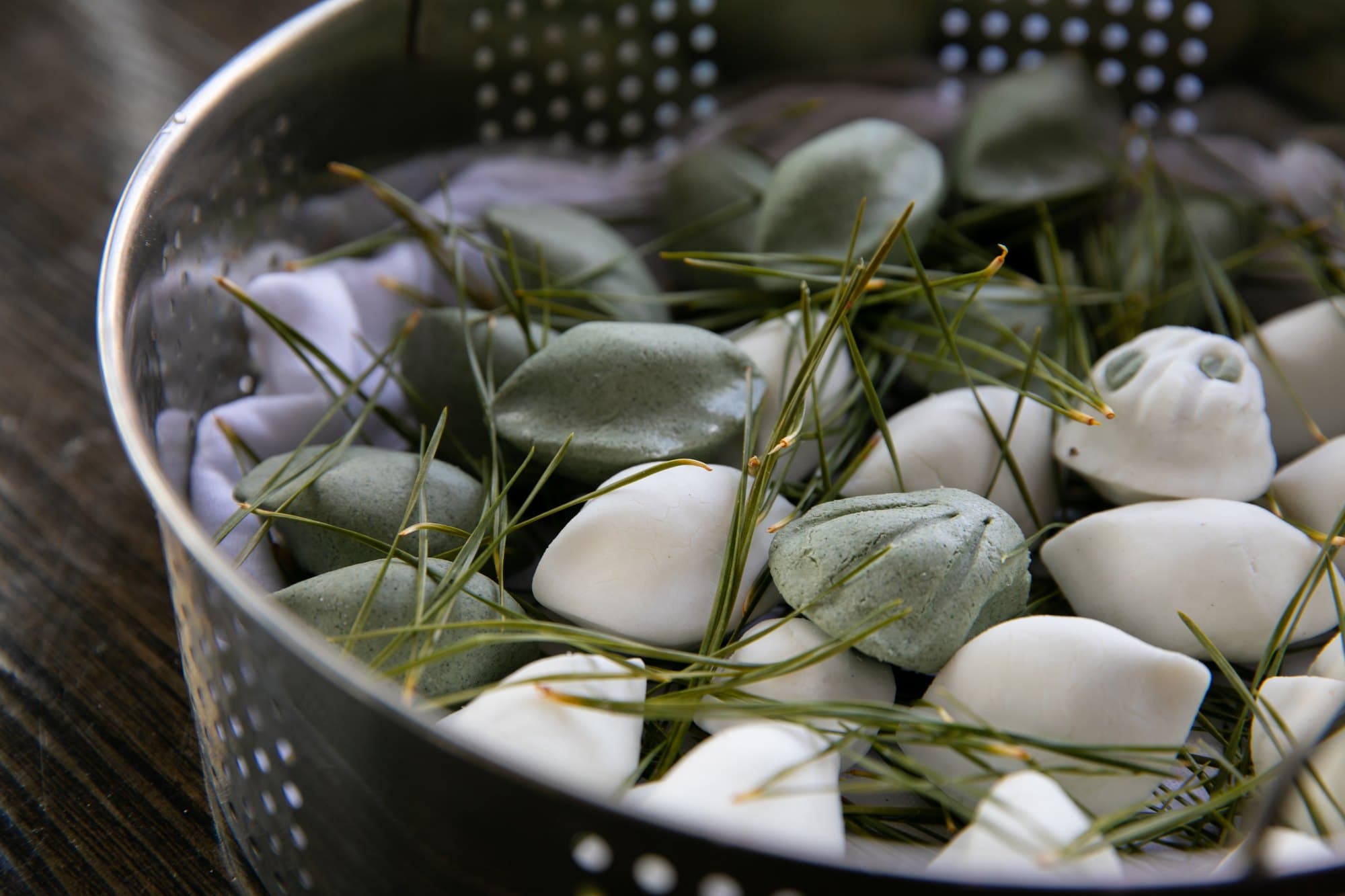
Photo by Kim Sunjoo. Licensed under CC BY-SA 2.0. Korea.net / Korean Culture and Information Service. Institute of Traditional Korean Food, Seoul; resized for web.
Chuseok Is Friday. Korean Families Keep the Harvest Table.
Friday is Hangawi, Korea’s harvest night. South Korea is off through Saturday. Korean families keep the same holiday in the North, in northeast China, and in American kitchens.
September 22, 2026
The steamer is lined with pine needles. White and mugwort-green half-moons sit on the cloth, pinched shut, waiting for steam. Those cakes are songpyeon. Friday, September 25, is Chuseok, Korea’s harvest holiday. People also call it Hangawi, the great middle of autumn.
South Korea is off Thursday through Saturday, September 24 through 26. Five-day workers get Sunday as well. Monday is a workday this year. The night itself is the fifteenth of the eighth lunar month, the same full moon Chinese families keep as Mid-Autumn.
The Encyclopedia of Korean Culture calls it the year’s biggest full-moon holiday. New rice is cooked for the ancestors, then eaten. The kitchen still follows that order.
Morning starts with charye, a memorial set wherever the family is gathering, often at the eldest household. Formal charye happens twice a year, on Chuseok and on Seollal, the lunar New Year. The New Year table uses white tteokguk. Chuseok uses newly harvested rice, and songpyeon goes on with it. After the bows, relatives eat from that same spread. The custom is called eumbok.
Later comes seongmyo, a visit to the graves. In the weeks before, many families do beolcho, cutting the grass around the mound. Apartments have shortened the rite. Public cemeteries have replaced some hillside plots. People still go when they can.
Songpyeon is the holiday cake. Rice-flour dough is stuffed with sesame or sweet red bean, sometimes chestnut or honey, then steamed over pine so the needles leave their scent. Families used to pinch them together on the eve. Jeon, the egg-battered pancakes, and a braise such as galbijjim usually sit on the savory side. Fruit comes out with the new crop.
Trains and expressways fill because the hometown still calls. A lot of shops post shorter hours for the same reason.
That crush is the South Korean weekend. Korean families keep the holiday in more places than those trains can go.
In the South it is a national holiday. The government made the day itself a public holiday in 1949. The day after became one in 1986, the day before in 1989, which is how the three-day block arrived.
North Korea kept the date and changed the terms. The Korea Herald reported that Pyongyang banned Chuseok in 1967 as a feudal remnant, allowed grave visits again in 1972, and restored a traditional folk holiday in 1988. It is one day there. Mass hometown travel is rare because movement is restricted. Lee Kang-hyuk, a defector who spoke to the Herald under a pseudonym, remembered carrying food up a mountain in Ryanggang Province and watching ssireum, Korean wrestling, with uncles. His hometown favored jeolpyeon, the stamped flat rice cakes. After the 1990s famine, many families stretched the holiday with corn or potato cakes. He lives in the South now and has said he has nowhere to go. The graves are still in the North.
Ethnic Koreans in China, the Joseonjok communities around Yanbian, keep Chuseok with new autumn clothes, grave weeding, and songpyeon, on the same date as the Mid-Autumn night around them.
In American cities the holiday often becomes a kitchen and a public lawn. Korean Center, the San Francisco nonprofit, is back on the Presidio parade ground this Saturday, September 26, for its eighth Bay Area Chuseok Festival. Last weekend about 1,500 people turned up in Blue Bell, Pennsylvania, for Happy Chuseok Fest. Plenty of families skip the festival and just steam a pot of songpyeon.
Chinese families share mooncakes that same Friday. Vietnam’s Tết Trung Thu leans toward children and lanterns, and Japan’s Tsukimi sets out dango and pampas grass for moon viewing, without a public holiday.
Friday is Chuseok. Korean families are already on the trains, at the graves, or at a steamer that smells like pine.