
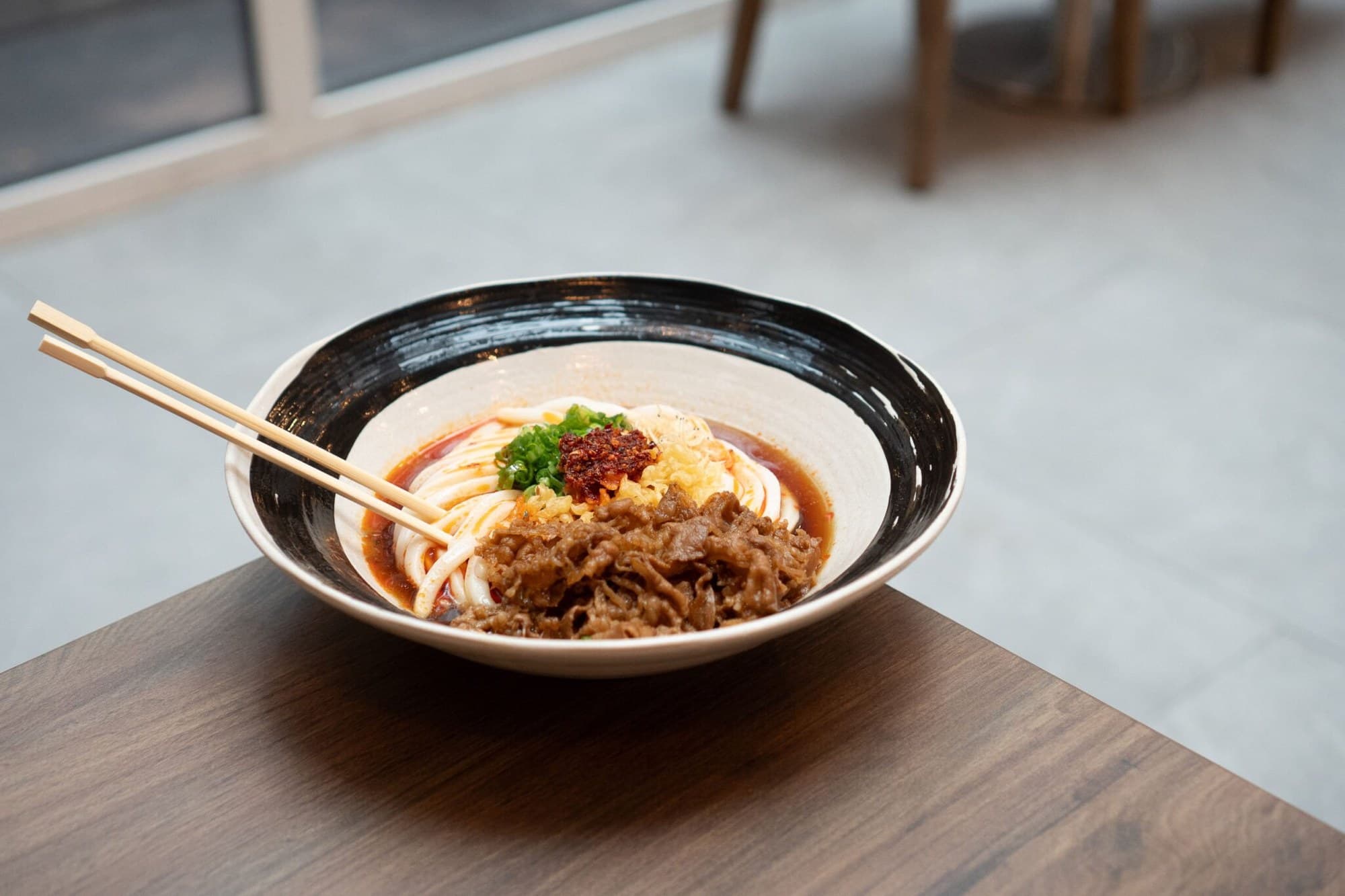
Photo by 7 Dreams Media. Licensed under Editorial use. Spicy cold niku udon at the Fifth Avenue shop, published with Edible Manhattan, October 22, 2026. Resized for web.
New Yorkers Were Riding to Boston for Eight Bowls of Udon
Yume Ga Arukara opened October 21 at 271 Fifth Avenue, its first shop outside Massachusetts. The noodles rest overnight. The menu is still eight bowls.
October 24, 2026
Between 29th and 30th on Fifth Avenue, Yume Ga Arukara opened on October 21. Eater’s list that day called it a full opening, at 271 Fifth Avenue. Back in January a staffer had told Eater that April was the plan, and that New Yorkers were already traveling to Boston for the noodles. The restaurant’s own site, checked Thursday, still lists Cambridge and the Seaport, with no address on Fifth Avenue.
The menu is eight bowls, and every one of them is udon: hot or cold, with beef or without, spicy or plain. Oliver Strand, writing in Edible Manhattan, found no appetizers, salads, or desserts. An onsen egg, more noodles, or more beef stays in the bowl. He called the noodles pillowy and toothy. On a cold bowl they carry tare, a seasoned sauce, and on a hot one they sit in chicken broth. They also take chili oil and a crunch of tempura flakes. He suggested starting with the spicy cold, the one with paper-thin beef.
The chew is a day’s work before anyone sits down. Tomohiro Shinoda, the chef who has run the kitchens, told Boston Magazine in February 2024 how the shops make the noodle. Flour goes into salt water, and the dough is cured, pressed, and left to rest overnight. Then it is stretched, cut, boiled for 20 to 25 minutes, and dropped in ice water. He cooks it that far, he said, because the snap he wants shows up after the shock. The dough’s moisture changes with the weather. Both Massachusetts shops use a Yamato machine from Japan, one of very few in the United States, he told the magazine. What Now reported that the Fifth Avenue kitchen is making the noodles in house on a machine brought from Japan.
Shinoda told Boston Magazine the usual hot soup mixes a dashi with a chicken broth that takes 12 hours. Dashi is the stock, often built from seaweed and dried fish. In Strand’s account of the new shop, the cold bowl is dressed with tare. The numbers he gave the magazine were for the Cambridge shop in 2024: about an even split of hot and cold in winter, and about 80 percent cold in summer. That kitchen was going through about 100 pounds of noodles a day, around 300 bowls.
Fifth Avenue is the largest of the three rooms, with seats on two floors and a glassed-in terrace upstairs, according to Edible Manhattan. What Now put the hours at 11 a.m. to 11 p.m. Monday through Thursday, and 11 a.m. to 1 a.m. Friday through Sunday. When the Seaport shop opened on February 19, 2024, it was the first kitchen they had built with room to cook more than the short menu. Shinoda told Boston Magazine they would start there on the classics, then add tempura, a yuzu-and-salt udon, and a cheesecake from Modern Pastry in the North End. He had started offering a biang biang noodle on Sundays in Cambridge, after the hand-pulled noodles at Gene’s Chinese Flatbread Cafe in Chinatown. Those noodles, he told the magazine, were very similar to his udon. Fifth Avenue opened on the eight bowls.
Tsuyoshi Nishioka and Juan Carlos Vidal opened the first counter in September 2017, in the food court at Lesley University in Porter Square. The name is 夢があるから. It means because I have a dream. Nishioka told Bon Appétit that was what he wanted to tell his children, if they asked why he worked so much. He already had another restaurant nearby, Yume Wo Katare, opened in 2012, with one heavy bowl of Jiro-style ramen. When you finish, the custom is to say a dream out loud. He sold his share of the udon shop in 2020. The two restaurants are separate companies, and Vidal stayed with the udon. In 2024 Lesley moved the Porter Square counter out of the food court and into the old Shaking Crab room at 1815 Massachusetts Avenue, with a door on the street. Cambridge Day still found a line that December.
Shinoda told the Boston Globe he grew up in Belmont. On a break from college in Seattle he finished a bowl at the ramen shop, then his sister’s, and Nishioka offered him a job on the way out. Nishioka taught him the udon for about three weeks and went back to Japan. After that, Shinoda spent two weeks at an udon school in Kagawa, a prefecture on Shikoku known for the noodle, and learned soba by hand at Kamonegi in Seattle, Mutsuko Soma’s restaurant. The soba, he told Boston Magazine, was completely by hand, with no machine, and it was the fragile one that taught him the most. Eater wrote that the soba work pushed him to stay with one style of noodle. For the Seaport he ordered a machine from Japan so the new bowl would taste like Cambridge. Fifth Avenue is a bigger room, and the dough still rests overnight.