
What the Number on the Fish Sauce Is Counting
40°N is grams of nitrogen in a liter. Keep a Vietnamese bottle for nước chấm, and a Korean anchovy sauce for kimchi.
Updated October 18, 2026
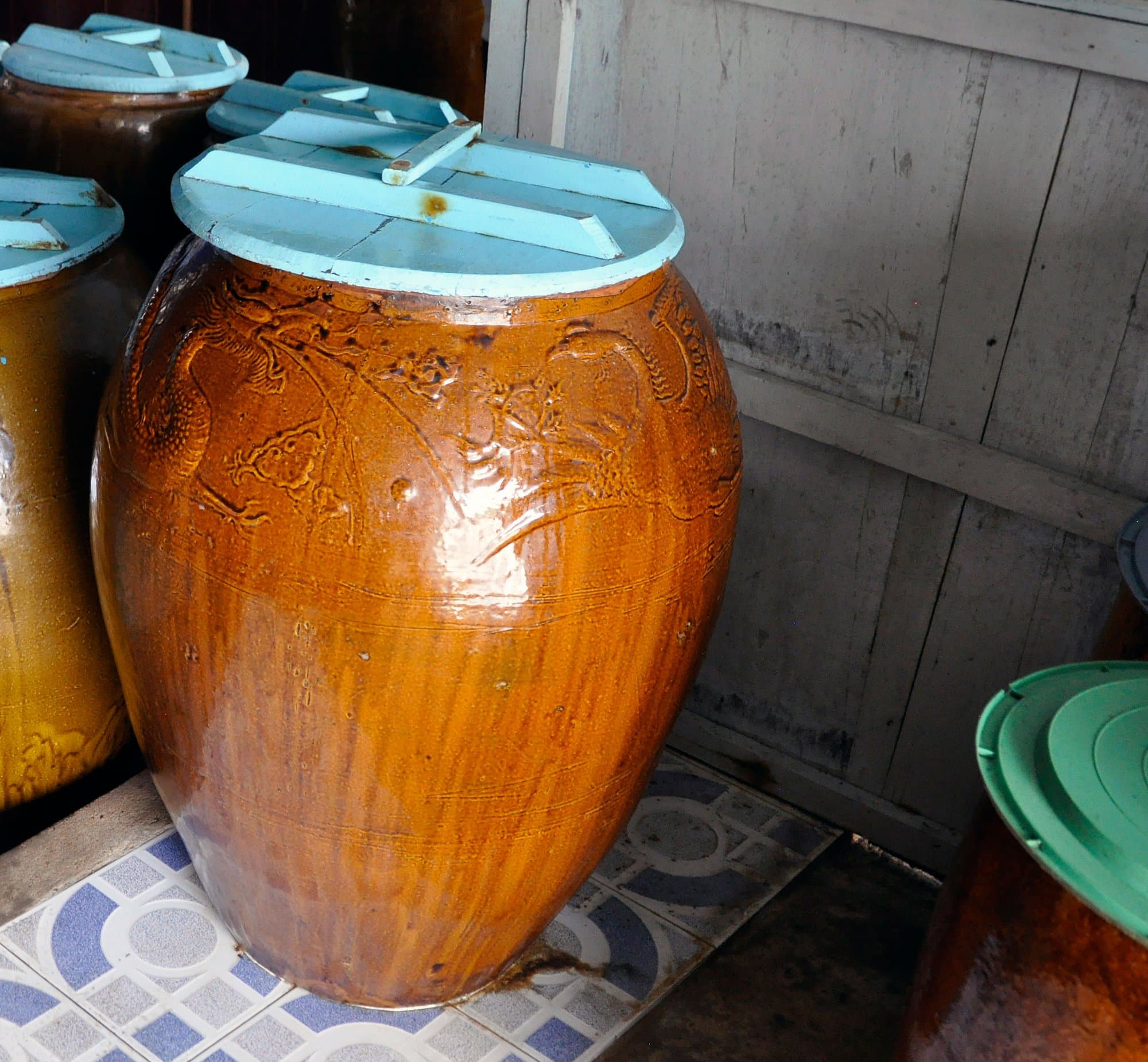
Photo by P. Hughes. Licensed under CC BY 4.0. Fish sauce fermentation jars, Mekong Delta, Vietnam, 2015. Cropped and resized for web.
The brown bottles look like one product until you turn them. One prints 40°N. One says nam pla under a squid. One, in Hangul, says anchovy sauce.
All three are fish sauce. The number on the Vietnamese bottle changes how much you pour.
The liquid seeps out of fish packed in salt and left alone. In Vietnam that wait is at least six months. The first draw, nước mắm cốt, is the rich one. Brine can go back through the spent fish for a thinner sauce, nước mắm long. Either one can end up in a brown bottle. If the label says hydrolyzed protein, the fish was broken down with acid. Leave that one on the shelf.
What the number counts
On a Vietnamese bottle the figure is độ đạm, written °N. It is grams of nitrogen in a liter, from the fish’s protein as it breaks down. A higher number is a more concentrated liquid. In the same stir-fry, a 40°N bottle takes a smaller splash than a bottle sitting at the floor.
Vietnam’s current standard, TCVN 5107:2018, splits that shelf in two. Nước mắm nguyên chất is fish and salt, fermented at least six months, with no additives. The label should say so. Ordinary nước mắm is made from that liquid. Brine, sugar, and additives are allowed, and the color and the aroma can be adjusted. Both have to reach 10 grams of nitrogen per liter, and at least 35 percent of it has to be amino nitrogen from the fish protein. The international food standard, Codex, uses the same 10-gram floor.
Until 2018, Vietnam graded bottles from 30 grams per liter for đặc biệt down to 10. The current standard dropped the grades and kept the floor. The old names still show up on labels, and on Phú Quốc they still sort the protected sauce.
That sauce has a geographical indication, in Vietnam since 2001 and in the European Union since 2012. The fish are anchovies, at least 85 percent of the mix, caught off Kiên Giang and Cà Mau. In the Mekong the jars are often ceramic, like the ones above. Phú Quốc’s protected sauce spends at least a year in wooden vats on the island.
A 2023 provincial rule still grades the protected sauce. Đặc biệt starts at 35 grams per liter, thượng hạng at 30, hạng 1 at 25, and hạng 2 at 20. The island’s association describes the liquid as running from 20 to 43 grams per liter. A bottle printed 40°N is claiming a place above the line for đặc biệt.
Turn the bottle over in an American store and the panel lists protein per tablespoon, sometimes only a couple of grams. Độ đạm is the nitrogen in a whole liter.
At the table
Nam pla is the Thai name. One familiar bottle on a US shelf prints a squid. At the table it usually shows up as phrik nam pla, a little dish of the sauce with chopped bird chile, sometimes garlic and a squeeze of lime. It goes over rice, a fried egg, or grilled fish.
Korean anchovy sauce, 멸치액젓 (myeolchi-aekjeot), goes into kimchi and into stews. It is the stronger, fishier bottle. Sand-lance sauce, 까나리액젓 (kkanari-aekjeot), is the milder one, for a jar that should taste less of anchovy. Korea’s standard also covers a seasoned anchovy sauce, 멸치조미액젓, which may be cut with brine and is allowed less nitrogen. For kimchi, buy the plain anchovy or the sand lance.
Patis is the clear Philippine fish sauce, from salted anchovy or sardine, in the same family as bagoong, the paste. It goes into sinigang, the sour soup, and it sits on the table for rice.
The spoon
Nước chấm is the dipping bowl: fish sauce loosened with lime, sugar, and water. Garlic and chile if you want them. Taste a spoon of it on a spring roll. The roll should taste savory and bright.
In a stir-fry or a soup, add a small spoon early. It does the work of salt, and the sharp smell settles as the pot heats.
Crystals in the neck of the bottle are ordinary. The sauce itself should stay clear. Keep the cap tight, in a cupboard, unless the label says to refrigerate.
To start, we recommend one bottle with fish and salt on the label. If you make nước chấm, get a Vietnamese nguyên chất and read the degree. Twenty or higher already meets the lowest Phú Quốc grade. Ten grams is the floor the national standard set, and you will pour more of a bottle that sits there. If this week is kimchi, get plain Korean anchovy sauce, or sand lance.