
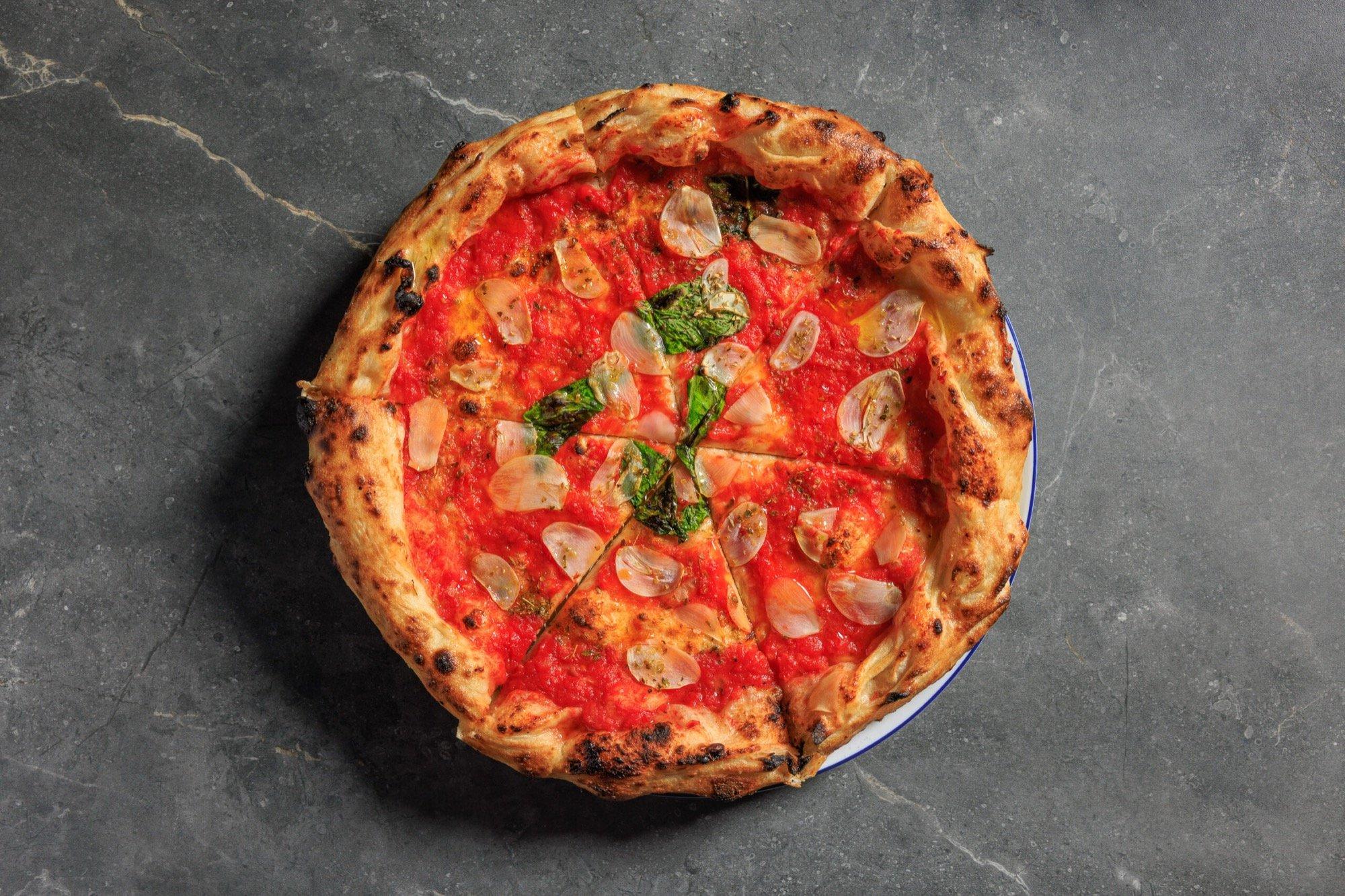
Photo by Miami Chef / Nelson Tirado. Licensed under Courtesy Royale Pizza Napoletana press. Press still of Royale’s marinara. Resized for web.
Tokyo-Style Pizza Means Longer Dough, a Blistered Rim, and Salt in the Oven
Royale Pizza Napoletana opens November 27 on Miami Beach with Chef Bun from Tokyo’s Savoy. The house documents flour, softened water, 30-plus hours of fermentation, and an 800-degree bake. Pinch shaping and the salt punch are still unspoken.
November 21, 2026
Royale Pizza Napoletana is listed to open Friday, November 27, at 1680 Meridian Avenue in Miami Beach. The Miami Guide and Secret Miami both corrected an earlier November 18 date. The room seats about sixty-five, takes walk-ins at a counter, and calls itself South Florida’s first Tokyo-style Neapolitan pizzeria. Bungo Kaneko, better known as Chef Bun from Tokyo’s Savoy, is on the project with Jess Varughese, who founded Miami’s Haiku. Chef Dalila Sabatino worked with Bun and later at Los Angeles’s Pizzeria Sei. Haiku’s Albert Diaz is on the kitchen list in the press release too.
The pies still look related to Naples: round, wood-fired, tomato and mozzarella in the classic lane. What people mean by Tokyo-style is the dough clock, the oven work, and the finish. Those choices pull away from the Associazione Verace Pizza Napoletana rulebook in ways you can name.
Dough that runs longer than Naples allows
AVPN’s 2024 English disciplinare caps overall fermentation between twelve and twenty-four hours. Cold refrigeration sits outside that method. The association’s proofing guidance keeps the dough awake at room temperature or in a controlled chamber. Tokyo kitchens often stretch the clock. At Seirinkan, Susumu Kakinuma has talked about Japanese flour and multi-day proofing. Matt Goulding, writing for Airbnb Magazine, put Kakinuma’s dough at about seventy-two hours. Visitors on the Pizza Making forum who asked the shop directly reported two days at about 12°C. Tsubasa Tamaki trained under Kakinuma, later told Chowhound he coined the phrase “Tokyo-style pizza,” ferments about thirty hours, and blends Japanese, American, and Canadian flours. Bun, in a 2022 Stir the Pots interview from his Savoy years, described long, low-temperature fermentation with a little yeast, and Italian plus Japanese flour.
Kakinuma opened Savoy in 1995 after a year eating through Naples, then Seirinkan on the original Savoy site. Food & Wine’s Ugly Delicious restaurant list and Craig Mod’s 2017 Eater guide both treat that lineage as the start of the Tokyo wave. Craig Mod quoted Kakinuma calling the pies “Kakinuma-style,” his own take rather than a strict Neapolitan copy. Keep the Neapolitan skeleton. Change the dough clock and the flour.
Hotter char, closer to the fire
Neapolitan ovens already run hot. Tokyo rooms chase more char than AVPN prefers. The disciplinare wants a cornicione one to two centimeters high, evenly alveolated, without big bubbles and burned spots, soft enough to fold. Tokyo pies often look different: a taller, blistered rim with leopard spots, and a thinner center that holds together instead of going soupy. Tamaki told Chowhound wood ovens can hit about 900°F, with the pizzaiolo turning the pie so the bubbles char evenly, sometimes seating it close to the flames. Goulding watched Tamaki work at roughly 480 to 500°C, under a minute a pie, with wood chips thrown on for a short smoke. Eater’s Tokyo guide put an extra punch of salt and a delicate dough in the same package.
William Joo’s Pizzeria Sei in Los Angeles built a following on that rim. Joo told Eater LA he pinches the crust the way Japanese shops do, so the edge turns mochi-like, soft and crunchy in the same bite. Sabatino worked in that kitchen. The Miami team inherits that conversation without claiming every Tokyo shop cooks the same way.
Pinch the rim, salt the oven
Two finishing moves keep turning up. First, shaping. Instead of a smooth slap-stretch into a clean ring, many Tokyo pizzaioli pinch and rotate the edge so air stays in irregular pockets. Those pockets blister in the oven. Second, salt. Tamaki’s “salt punch” throws Okinawan salt onto the oven floor so crystals bake into the underside of the crust. He told Chowhound and Broadsheet he learned that at Savoy. Food & Wine’s American pizza survey described the same salty bottom as a Tokyo tell. You get more texture, and a sharper savor, on a dough that may run lighter on salt inside the ball.
Plenty of Neapolitan shops skip both and still bake well. A kitchen that leans on the pinch and the salt punch is usually talking Tokyo.
What Royale has actually written down
Royale’s own site puts the craft in one line: more than thirty hours of fermentation, 180 seconds of heat. The November press release and earlier reporting in Miami New Times, Time Out Miami, Robb Report, and Profile Miami add the dough story the house is willing to name. A blend of artisan flours. Autolyse to handle particle-size differences between what they can buy and what Bun used in Japan. Miami water run through a softener to mimic softer Japanese water. Bulk and cold fermentation dialed in over hundreds of hours of testing. Pies out of an 800-degree oven. “The dough is everything,” Varughese told Miami New Times.
That lines up with the longer ferment, the flour fussing, the water chemistry, the high heat, Bun from Savoy, and Sabatino from Sei. The public materials still leave out the salt punch into the oven floor, the pinch-and-ripple stretch, Japanese mill flour by name, and wood chips for smoke. The Marinara on the opening menu does list Okinawa salt with Rega tomatoes, garlic, oregano, basil, and olive oil at $24. That is salt on the pie, a different claim from salt on the oven floor. Margherita is $27. Specialty pies climb from there, including Angie Mieux, a tuna pie that echoes Bun’s Savoy tuna with wasabi sauce.
Royale has written down the first half of the Tokyo list. The pinch and the salt punch are what to watch for once the peel is working on Meridian. Opening day is November 27. Hours on the site run Wednesday through Monday, 11:30 a.m. to 9:30 p.m., closed Tuesday. No reservations.