
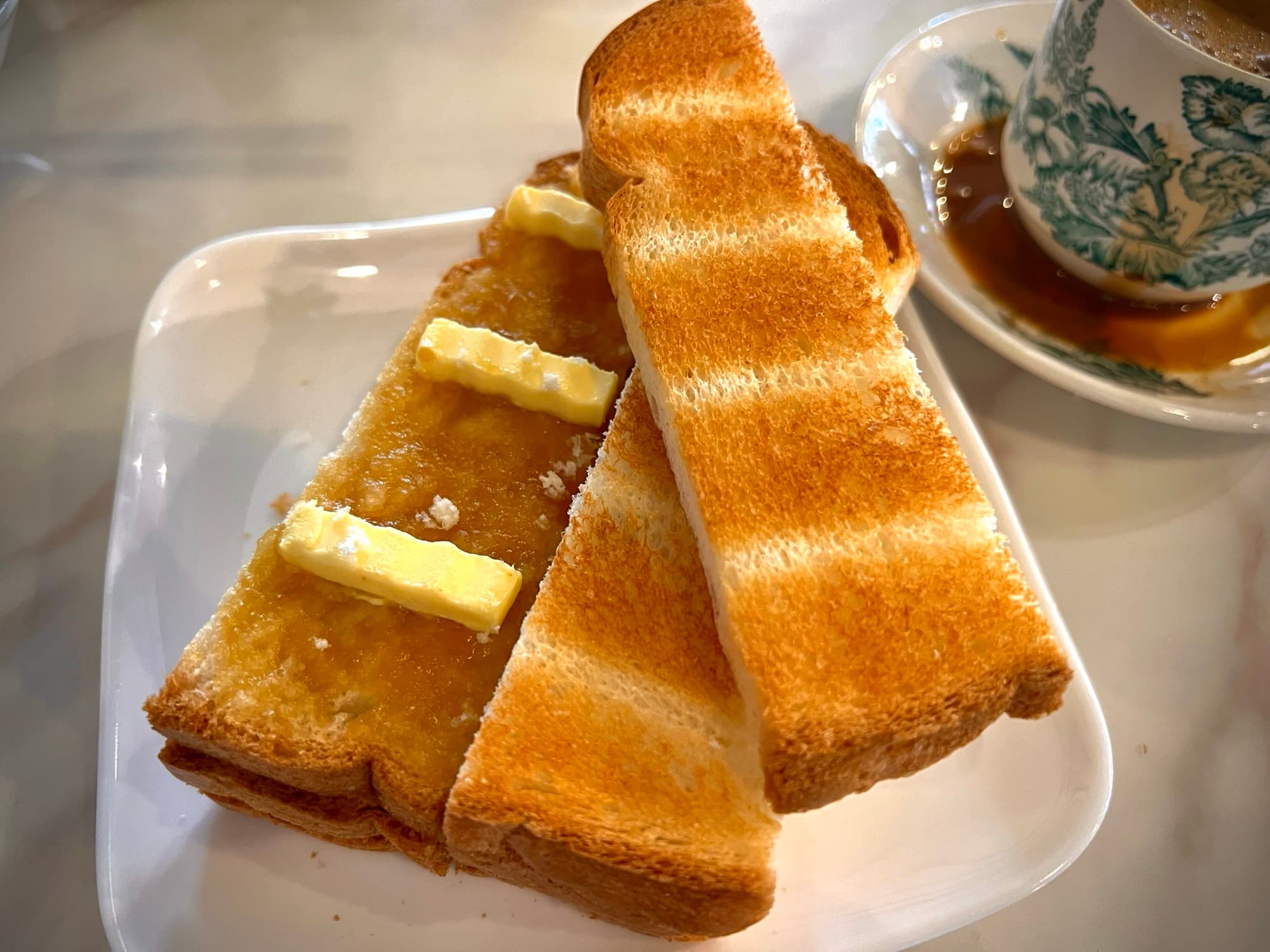
Photo by Sharon Hahn Darlin. Licensed under CC BY 2.0. Resized for web. Photographed at Yinzo Kopi in Ipoh, Malaysia.
Kopi Tiam Mornings Run on Toast, Eggs, and Kopi
Hainanese cooks turned a colonial breakfast into the shared morning table of Singapore and Malaysia.
July 25, 2026
The plate looks simple until you sit with it. Thin toast, a sweet coconut jam called kaya, a cold slab of butter that starts to melt into the heat. Two soft-boiled eggs broken into a saucer with dark soy and white pepper. A cup of kopi sweet enough to surprise anyone raised on black drip.
That combination is the morning grammar of Singapore and Malaysia. You meet it in neighborhood coffee shops, hawker centres, and chains that bottled the nostalgia. Locals call the room a kopi tiam: *kopi* from Malay for coffee, *tiam* from Hokkien for shop. The meal is often called a Nanyang breakfast, using the Mandarin word for the South Seas that once named this stretch of Southeast Asia for Chinese migrants.
A British breakfast, rewritten
The story begins with migration, not with a franchise logo. Hainanese migrants arrived in the Straits Settlements later than larger Chinese dialect groups. Many found work as cooks and stewards for British and European households, Peranakan families, hotels, and ships. In those kitchens they learned toast, jam, eggs, and coffee service. When they opened their own shops, fruit jam became kaya, an egg-and-coconut spread with Malay confection roots that food historian Khir Johari links to the wider serikaya family. Pandan often greens the Peranakan style. Caramelized sugar browns many Hainanese versions.
After the Japanese Occupation and the thinning of British employers, Hainanese cooks turned those skills into coffee shops. Foochow operators became major players too. By the 1950s, press and association histories estimate that Hainanese and Foochow owners ran most of Singapore’s coffee shops. Killiney’s lineage reaches back to a 1919 coffeeshop on Killiney Road. Ya Kun began with Loi Ah Koon, a Hainanese migrant who started as a coffee-stall assistant in the 1920s and registered Ya Kun Coffeestall in 1944. Chains later carried the plate abroad. The older form stayed local: marble tables, floral cups, and neighbors who did not need a menu explained.
What is in the cup
Kopi is not a generic latte. Traditional Nanyang coffee leans on robusta beans roasted with margarine, sugar, and salt until the outside caramelizes, then brewed through a cloth sock filter. Condensed milk is the default sweetness. Order language is its own map. Kopi means coffee with condensed milk and sugar. Kopi O is black with sugar. Kopi O kosong is black with nothing added. Kopi C swaps in evaporated milk. Siew dai asks for less sweet. Peng puts it on ice. The same modifiers travel to teh, the tea twin on the board.
The eggs are not an afterthought. Soft whites and runny yolks get seasoned at the table, then used as a dip for the toast. Charcoal grilling is the romantic method. Electric grills do much of the daily work now, and factory bread has largely replaced homemade loaves. The kaya is the part shops still treat as identity. Singapore’s National Heritage Board lists the traditional breakfast of kaya and kopi on its intangible cultural heritage inventory. In December 2025, the Foochow Coffee Restaurant and Bar Merchants Association opened a Coffee Shop Heritage Gallery on Tyrwhitt Road, a reminder that the industry still sees itself as social infrastructure, not only toast retail.
Why the morning still matters
A kopi tiam is a breakfast room and a neighborhood bulletin board. Uncles read papers. Workers grab a set before the MRT. Families teach children how to crack the eggs without flooding the saucer. In Malaysia the same trio shows up from Ipoh to Johor, often in Hainanese family shops that have outlasted fashion. In Singapore, coffee shops in HDB estates keep feeding people who are not hunting a destination café. The room has absorbed other stalls and other cuisines over time. The morning set remains the handshake.
Hawker centres can feed you for the rest of the day. Convenience stores can feed a late night. The kopi tiam breakfast answers a different need: a cheap, shared start that carries immigrant kitchen memory without asking you to book a table. Dip the toast. Drink the kopi while it is hot. Leave the floral cup for the next person who already knows the order.