
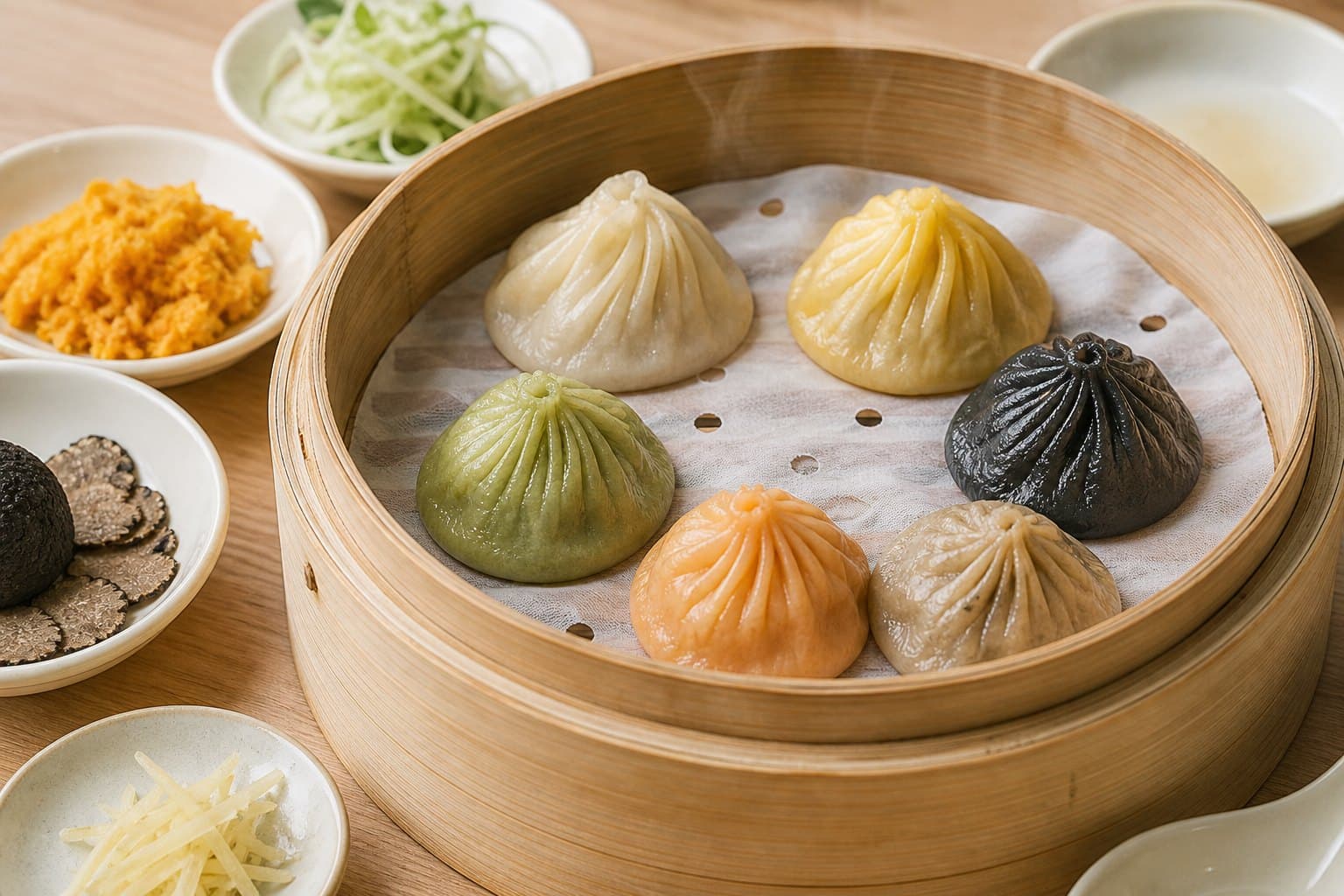
Photo by East Table. Licensed under Editorial. Generated still life without brand marks; resized for web.
The Six-Color Soup Dumpling Basket and the Problem With Novelty Xiao Long Bao
JoyFu’s Chinatown sampler arrives in six colors. The harder question is when a flavored dumpling expands the Jiangnan form, and when the palette is doing most of the work.
August 20, 2026
JoyFu opened on Mulberry Street in late July with a kitchen window that lets you watch cooks fold xiao long bao, and with a six-piece sampler that gathers every variety the house makes into one bamboo steamer. Eater’s August openings list flagged the basket, naming black truffle and crab roe among the fillings. The Infatuation later put the sampler at $16.50 and added shrimp to the short list. Anyone with a phone knows the picture already: a ring of dumplings in soft green, gold, charcoal, and blush, shot from overhead before anyone has burned a mouth on the broth.
Shanghai kitchens have sold more than plain pork for a very long time, so novelty by itself is not the complaint. The test at a six-color basket is narrower. Does each dumpling still behave like xiao long bao once the lid comes off, or has the palette done most of the work?
A traditional Jiangnan soup dumpling is a small engineering problem. The wrapper has to be thin enough to turn translucent in the steamer and strong enough not to tear when the filling turns liquid. The liquid is not injected. Cooks simmer pork skin and bones into a collagen-rich stock, chill it into aspic, and fold cold cubes of that jelly into seasoned meat. Heat melts the gel back into broth. Pleats close the top. Vinegar and young ginger on the side cut the richness of the pork. Those are the jobs the dumpling has to finish. Everything else is a variation on them.
Crab roe belongs to that lineage. In Shanghai and nearby cities, crab and crab-roe xiao long bao have long sat above plain pork as a seasonal luxury, denser and more expensive, with roe that changes how the broth tastes on the way down. Truffle is a newer prestige move. Chains from Din Tai Fung to Flushing’s Nan Xiang have put black truffle next to pork because diners already treat truffle as a signal of spending. It can deepen a dumpling when the fungus is actually in the filling and the broth. It can also be a perfume sprayed on a pork dumpling that would have been fine without it.
Color is where the category gets slippery. Home cooks and some restaurants tint wrappers with spinach, carrot, purple cabbage, turmeric, or squid ink, which can leave a faint vegetable or marine note and help a diner tell one filling from another. Flushing’s Shanghai You Garden has built a reputation on skins dyed so the table can sort crab from pork at a glance. Nan Xiang’s Lucky Six sampler sells the same idea as a tasting flight. None of that is automatically a crime. Spinach juice in the dough leaves a trace of spinach in the finished skin, a small decision about flavor. A wrapper tinted so the basket photographs in six colors is a decision about the photograph.
JoyFu has not published a breakdown of how each of its six skins gets its color, and a diner should not invent one. Ask, or taste past the palette. If the charcoal dumpling and the ivory dumpling deliver the same broth and the same pork, the color was a label. If the crab-roe one tastes richer and the shrimp one cleaner, the sampler earned its ring.
Novelty fillings also stress the wrapper. Aspic still has to melt cleanly. A filling loaded with aromatics, cheese, chocolate, or a broth borrowed from another cuisine can leave you with a thick skin and a muddled interior that no longer needs the spoon-and-sip ritual that makes xiao long bao worth the burn. At that point the dumpling has turned into a container for something else, and the spoon has nothing to do. The expansion holds when the soup still arrives hot and clear in character.
The dipping sauce is the quiet tell. Classic pork wants black vinegar and ginger because fat needs acid. Crab-roe versions want a lighter hand so the shellfish still comes through. Din Tai Fung’s own guidance on truffle xiao long bao is to go easy on the vinegar-soy dip so the truffle is not drowned. If every color in a six-piece basket gets the same aggressive dunk, the kitchen may have built six looks and one flavor.
Pricing makes the same argument in numbers. In Chinatown, a classic order of eight pork soup dumplings at a place like Joe’s Shanghai still sits in the mid-teens, with crab-and-pork a couple of dollars higher. JoyFu’s six-piece sampler at $16.50 is not outrageous for Manhattan dim sum in 2026, but it is a premium per dumpling. You are paying for variety and for the prestige fillings, which is fair when the truffle and crab roe change how the dumpling tastes and steep when they do not.
None of this argues against ordering the sampler. A flight is a fast way to learn a kitchen’s range, and a window onto the folding shows you more than most dumpling shops do. It just leaves the judging to the diner. Eat the plain pork first, while your palate is still honest, then work through crab roe, shrimp, truffle, and whatever else the basket holds. Go light on the vinegar with the delicate ones. Watch whether the wrapper stays thin and holds, and whether the broth actually changes from one color to the next.
A flavored xiao long bao earns its place when it still solves the old problem: thin skin, hot soup, a filling with a point of view. If the only thing that changed is the color, you paid for the photograph.