
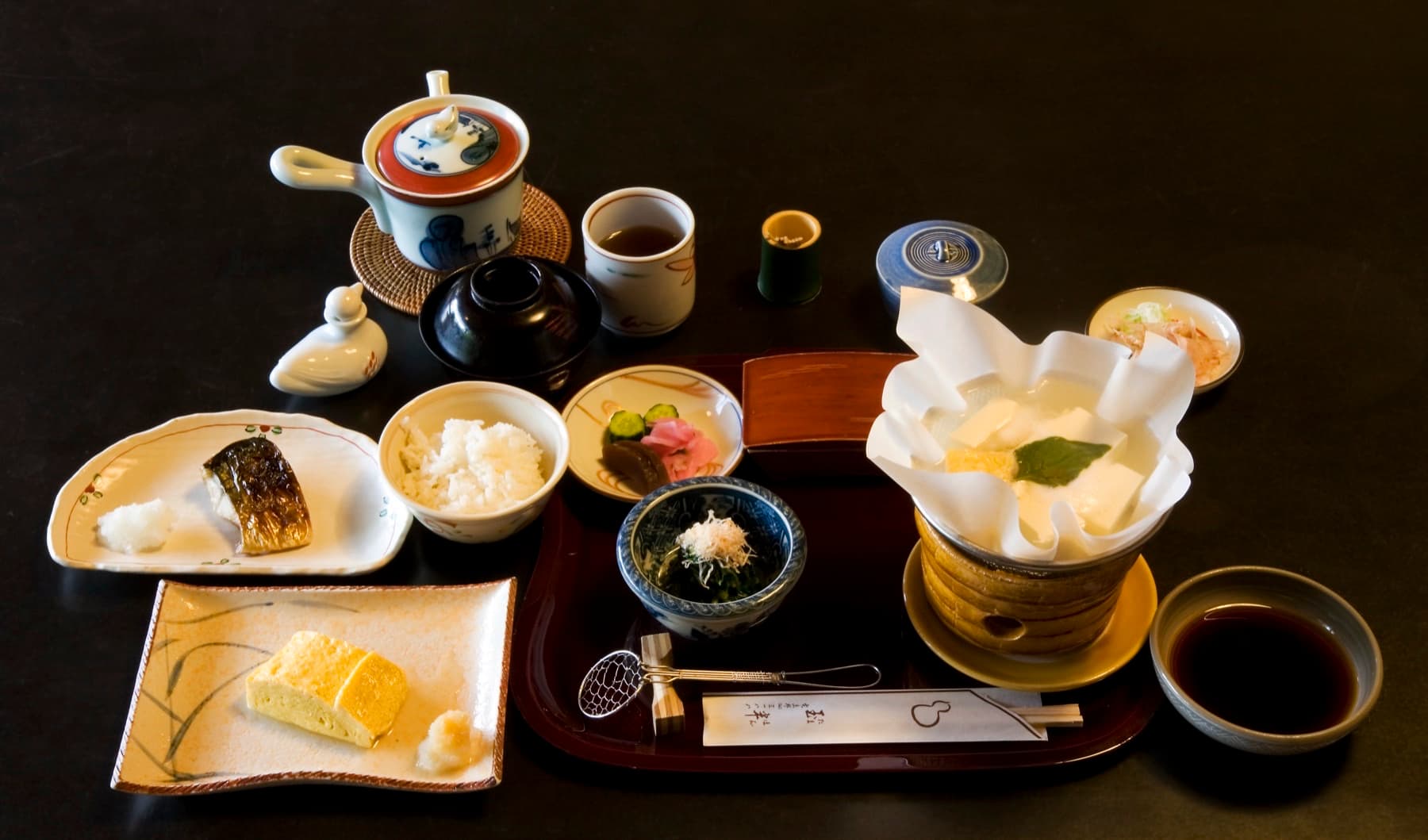
Photo by Michael Maggs. Licensed under CC BY-SA 3.0. Breakfast at Tamahan Ryokan, Kyoto; resized for web.
The Japanese Breakfast Is Becoming America’s New Luxury Brunch
Rice, grilled fish, miso soup, pickles, and tamagoyaki are showing up on trays from Little Tokyo to Brooklyn as a calmer, savory alternative to sugar-heavy weekend brunch.
August 4, 2026
American weekend brunch has a familiar silhouette: tall stacks, whipped cream, bottomless mimosas, and a plate that asks you to finish dessert before noon. Across more U.S. cities, another morning tray is pulling the same reservation energy for the opposite reason. It arrives as a set of small bowls: steamed rice, miso soup, a piece of grilled fish, pickles, often tamagoyaki, sometimes tofu or a seasonal vegetable. The room stays quieter. The sugar stays lower. The meal still feels like an occasion.
In Japan that pattern is ordinary. Homes, business hotels, and ryokan inns serve a morning version of washoku’s ichiju-sansai logic, one soup and three dishes beside rice and pickles. What changed in North America is the framing. Chefs put the same grammar on a brunch menu, charge a set price, and let diners discover that fish and rice before noon can feel luxurious when every dish is portioned and arranged.
What lands on the tray
A classic Japanese breakfast is a complete meal, not a pastry course. Rice sits as the carbohydrate center. Miso soup hydrates and warms. Grilled salted salmon or mackerel is the usual protein, though tofu or eggs can lead. Tsukemono cut through with acid and crunch. Tamagoyaki or dashimaki adds a soft egg layer. Nori, natto, or a small ohitashi of greens show up depending on the kitchen and the season.
Hotels and inns often expand the tray into many tiny plates because breakfast is where a kitchen shows local fish, house pickles, and regional miso. American restaurants usually compress that into five to seven components on one tray, priced as a teishoku set. The luxury is less about rare ingredients than about time, ceramics, and the feeling that someone already decided the balance for you.
Where the trays are booking up
In Los Angeles’s Little Tokyo, Azay built a following around a Japanese breakfast that Food & Wine reported at about $23, with owner Philip Hirose saying the restaurant sells roughly two hundred sets a week. The tray typically runs miso soup, grilled fish or a vegan tofu-maitake swap, silken tofu, tamagoyaki, rice, and seasonal vegetables. After a fire closed the room for months, breakfast and lunch became the main event when it reopened.
Brooklyn’s Okonomi has served ichiju-sansai sets since 2014 and later opened a Manhattan daytime room. Former Okonomi cooks JT Vuong and George Padilla made a roughly $28 Japanese breakfast a brunch bestseller at Rule of Thirds in Greenpoint, sitting beside soufflé pancakes rather than replacing them. Elsewhere, Masako Morishita’s Perry’s in Washington, D.C., has run Saturday Japanese breakfast tickets around $42; Kadence in Orlando takes Sunday reservations; Kisser in Nashville and Itoko in Chicago have added traditional sets; Gyukatsu Rose in Orlando books Saturday morning trays with tea. In Canada, Vancouver’s Yama Cafe lists a Morning Set with sockeye salmon or mackerel until 11 a.m., and Toronto’s Sakawa Coffee draws diners looking for a homestyle Japanese morning plate.
Confirm hours and prices before you go. These numbers move with the menu.
Calmer, not magic
Compared with a syrup-heavy American brunch, a Japanese breakfast usually brings more savory variety, fermented flavors from miso and pickles, and protein from fish or soy without a sugar spike. Nutrition surveys in Japan associate rice-and-sides breakfasts with different micronutrient patterns than bread-and-sweet patterns, and American brunch culture still leans hard on refined carbs and added sugars. That does not make every tray automatically “healthy.” Miso, pickles, and salted fish can push sodium up, and a restaurant set can be as rich as the kitchen wants it to be. The clearer appeal is pacing: many small dishes slow you down and leave you full without the pancake crash.
Nearby breakfast traditions help place the tray. A Korean morning often looks like dinner in miniature: rice, soup or stew, and shared banchan with kimchi at the center. Taiwanese breakfast shops lean on soy milk, youtiao, fan tuan, and danbing for a handheld start. Chinese mornings vary by region, from congee and baozi to fried dough with soy milk. The Japanese set is usually plated for one person on a tray, quieter in spice, and built around dashi and miso rather than a communal banchan pile.
A weekday version at home
You do not need twelve ceramics. Cook rice, heat miso soup (instant dashi is fine on a Tuesday), broil a small piece of salted salmon or use leftover grilled fish, and put out one pickle and one egg. Tamagoyaki is nice when you have time; a soft-boiled egg or raw egg stirred into hot rice works when you do not. Green tea or a simple coffee finishes the table.
Five make-ahead pieces keep mornings short: a batch of rice in the cooker or fridge for reheating, a jar of quick cucumber or cabbage pickles, a tub of miso soup base or frozen dashi ice cubes, salted salmon portions ready for the broiler, and a rolled omelet cooked the night before and sliced cold. Rotate one vegetable side when you can. That is enough to feel like a set without a Sunday project.
The same appetite for Japanese morning culture shows up next door in coffee omakase counters and hojicha desserts, where roasted tea and tasting flights get the reservation treatment once reserved for sushi. The breakfast tray is the savory cousin of that mood: small courses, careful pacing, and a table that treats morning as a meal instead of a sugar course. To start, we recommend booking one restaurant set this month, then copying the structure at home with rice, soup, fish, pickle, and egg.