
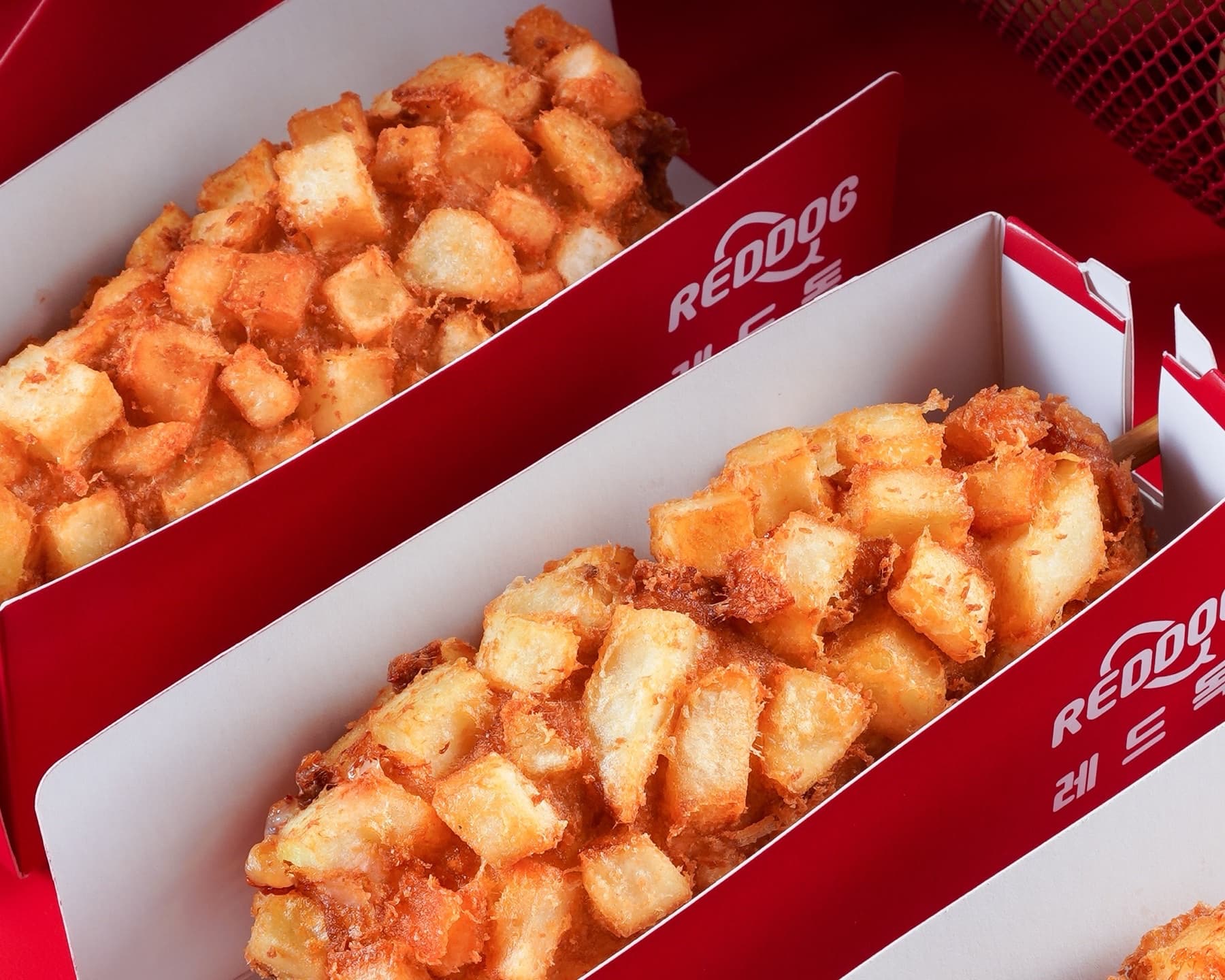
Photo by Reddog. Licensed under Brand. Courtesy Reddog; resized for web.
Reddog’s Korean Street-Food Business Is Surging in Indonesia
The bunsik chain’s first-half revenue jumped about 88 percent and operating profit about 143 percent. Tteokbokki and Korean corn dogs travel as counters, not as full Korean dining rooms.
August 13, 2026
Reddog sells Korean street snacks from mall counters and neighborhood shops across Indonesia: spicy rice cakes in a pot, corn dogs on a stick, trays you can carry while shopping. In the first half of 2026 the Jakarta-based chain reported group revenue of IDR 198.5 billion, up 87.9 percent from a year earlier, and operating profit of IDR 48.6 billion, up 142.9 percent. The half-year take was already about 97 percent of its full audited 2025 revenue. The company says it now operates and franchises more than 145 outlets.
Those numbers are the news. The format is the explanation. Reddog is a bunsik brand, the Korean category of snack-shop cooking that lives on a few high-turnover items rather than a banquet table of banchan. Founder and CEO Kim Hong-yeol and COO Cho I-jun have built the business as an operations system: short menus, repeatable kitchens, and cash-flow-funded expansion instead of a transplanted Seoul dining room.
Tteokbokki and Korean corn dogs scale for reasons full-service Korean restaurants often do not. A snack counter needs less square footage, fewer skilled cooks, and a thinner inventory than a grill table with meat cuts, lettuce wraps, and a rotating banchan line. Guests decide in seconds. Packaging is designed for walking. Delivery apps treat the order like fried chicken or bubble tea, not a two-hour meal. Reddog’s own Singapore site posts company unit economics that put average store build-out near USD 33,500 with roughly a one-year payback on 2025 figures. Those are management numbers, not an outside audit, but the direction is clear: small box, fast ticketing, high repeat.
Indonesia also asked the brand to localize. Reddog markets Halal certification on its Indonesian site, a real door for Muslim-majority diners who might skip pork-forward Korean barbecue rooms. Korean reporting says the chain imports hundreds of tons of Korean wheat flour for rice cakes and bread crumbs each year as stores multiply, so the snack boom also moves Korean ingredients through the same pipe. That looks less like opening another white-tablecloth Korean kitchen abroad and more like a snack brand with a kitchen counter.
Full-service Korean dining can thrive overseas when the room is the product: charcoal smell, shared grilling, a long evening. It is harder to stamp that experience into 145 mall units without training armies and leasing dining rooms. Reddog’s bet is the opposite. Keep the Korean signal in the sauce and the skewer. Keep the labor and footprint light enough that a franchisee can open next to a cinema.
The company is already testing the next map. It set up a Singapore entity in April and planned an August CapitaLand mall debut, with reddog.sg pointing to Funan as the beachhead. It is also in early talks with Indonesian securities firms about a possible IDX listing aimed at early 2027, with no underwriter mandated and no registration filed yet. Whether the IPO lands, the H1 print already makes the format argument. When Korean food goes abroad as bunsik, it can grow like a snack chain. When it goes abroad as a full dining culture, it usually has to grow like a restaurant.