
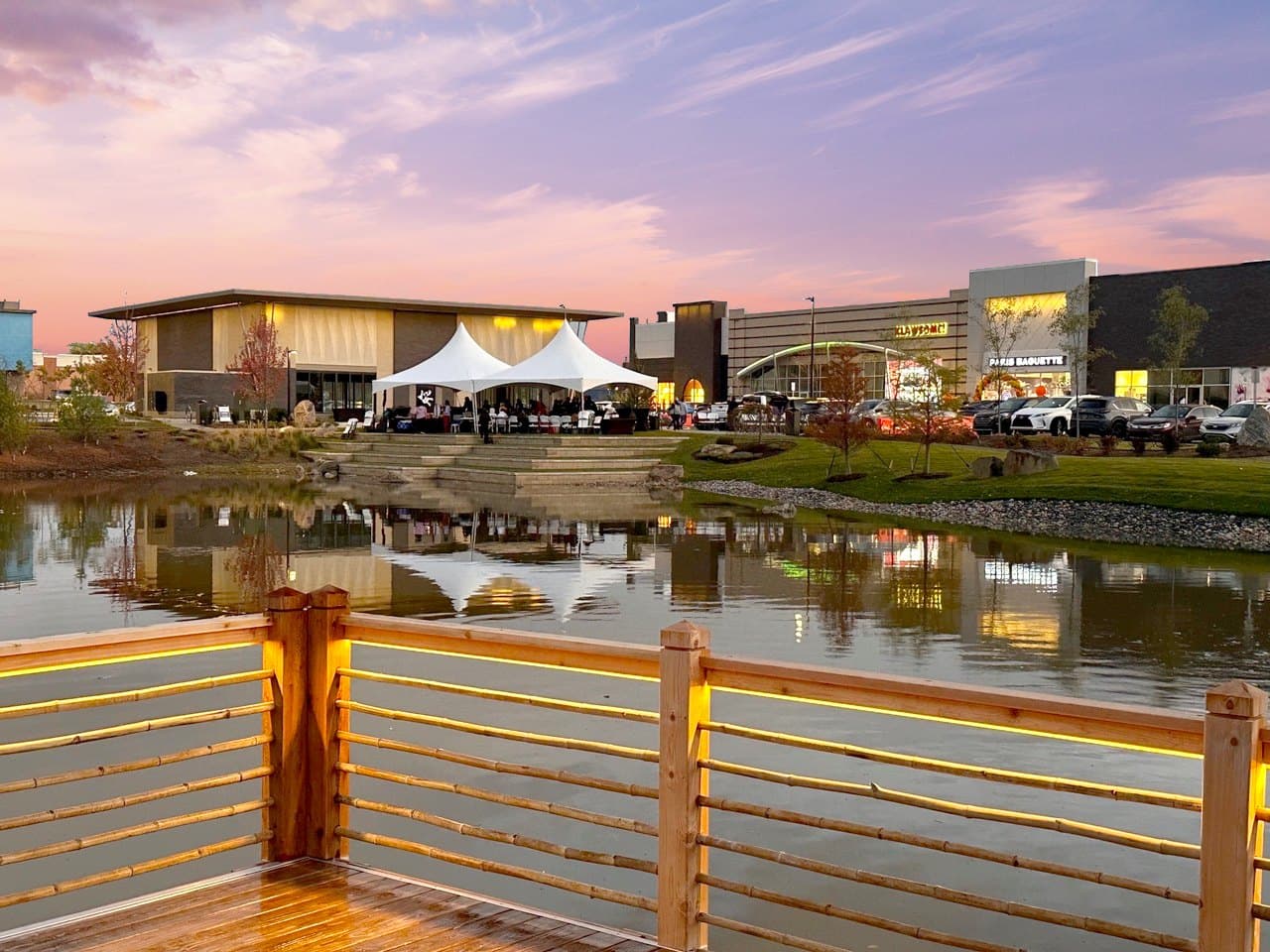
Photo by Sakura Novi. Licensed under Brand. Courtesy Sakura Novi; campus press photograph; resized for web.
Outside Detroit, Sakura Novi Is Building an Asian Dining Destination From Scratch
Sumo Japanese Grill just joined a Grand River campus that already holds Korean steakhouse, wagyu shabu, Paris Baguette, and Book Off’s first Midwest store. Novi’s Asian diners were already here.
September 3, 2026
Sumo Japanese Grill opened this week on Grand River Avenue in Novi, about 1,400 square feet of hibachi chicken, fried rice, noodles, and house sauces. A year ago the same stretch was still a construction site around a pond. Now the walk takes you past a Korean steakhouse, a wagyu shabu house, a Paris Baguette, a boba shop, and Japan’s Book Off secondhand chain before you reach the new grill.
The campus is called Sakura Novi. Developers Scott Aikens, of the Birmingham firm Robert B. Aikens & Associates, and Phil Kim call it Michigan’s first Asian-inspired mixed-use project: shops and restaurants on one side of a two-acre public garden, three-story townhomes from Robertson Homes on the other. The city sold them the old car-wash parcel years ago. The Consul General of Japan helped push the idea. Sumo’s opening is the latest sign the commercial row is filling.
The serious dinner reservation is The Dancing Pine, which opened in July at 4,500 square feet. Founder Min Kyu Kim hired chef James “JJ” Jung, who opened SET Steak & Sushi inside the Pendry hotel in Newport Beach and earlier cooked at Nobu. The room runs Japanese, Australian, and American wagyu on tabletop grills, with oysters, house banchan (the small side dishes Korean meals lean on), and a caviar program, Tuesday through Sunday from 4 to 10 p.m.
Chubby Cattle’s all-you-can-eat wagyu shabu house soft-opened in November 2025 as the chain’s first Michigan location. Tiers run about $48 to $78, with top-grade Japanese A5 cuts on the higher menus. Local operator Eric Mai, a Novi resident, told WXYZ he wanted the room to feel like a little Tokyo when you walk in. Paris Baguette has handled the morning and coffee crowd since its October 2025 grand opening, the same day the garden was dedicated with taiko drumming. Cloud Boba, from owner Michelle Hom, arrived in May with a long customizable tea list. Sumo covers the casual grilled plate.
The retail is what keeps a meal from being a single stop. Book Off, which has more than 850 stores in Japan and about nineteen in the United States, put its first Midwest shop here; by late February, Detroit News photographers were already catching weekend browsers in the manga and used-media aisles. Teso Life, a Japanese department store of snacks, stationery, and housewares, opened in May alongside the boba shop. Klawsome!, a claw-machine arcade from Michal and Agnes Filipowski, opened even earlier, in August 2025. Developers still say they want a salon, a brunch café, fitness, ramen, and sushi. The sidewalk already has enough reasons to linger.
Asian Americans made up 28.1 percent of Novi’s population in 2024 census figures cited by The Detroit News, up from 15.9 percent in 2010, while the city added more than 12,000 residents. Oakland County holds Michigan’s largest Asian American population. Novi has been the state’s densest Japanese community hub for years, with offices and suppliers for Toyota, Nissan, Subaru, and other auto firms nearby, Japanese-language help in schools and hospitals, and the Japanese School of Detroit a short drive west. Aikens has put the southeastern Michigan Japanese national population tied to that corridor at about 15,000.
City Manager Victor Cardenas has called Novi the unofficial home of Michigan’s Japanese population and said the campus builds on a relationship that was already decades old. For a long time those diners and shoppers still drove between ordinary strip plazas. Sakura Novi puts the parking lot in the middle and the walk around a pond, with bilingual signage and cherry-blossom panels that light at night, on a site local reporting puts at about fifteen acres between Grand River and Eleven Mile.
Early crowds matched the pitch. Chubby Cattle and Paris Baguette drew lines out the door in their first months. Mayor Justin Fischer, speaking at the garden dedication, admitted he had once voted against key approvals and thanked the developers for proving him wrong. Aikens has talked about $25 million in projected annual revenue from a ten-mile radius of more than half a million people. Those are his projections.
A diner can now walk from Korean steakhouse to wagyu hot pot to hibachi to a Korean bakery chain without moving the car, then lose an hour in Book Off. That kind of cluster is familiar in parts of Southern California and northern New Jersey. On this Grand River frontage, it is still young. Sumo’s hours run from late morning into evening. The Dancing Pine holds the dinner shift. The campus is open to anyone who shows up.