
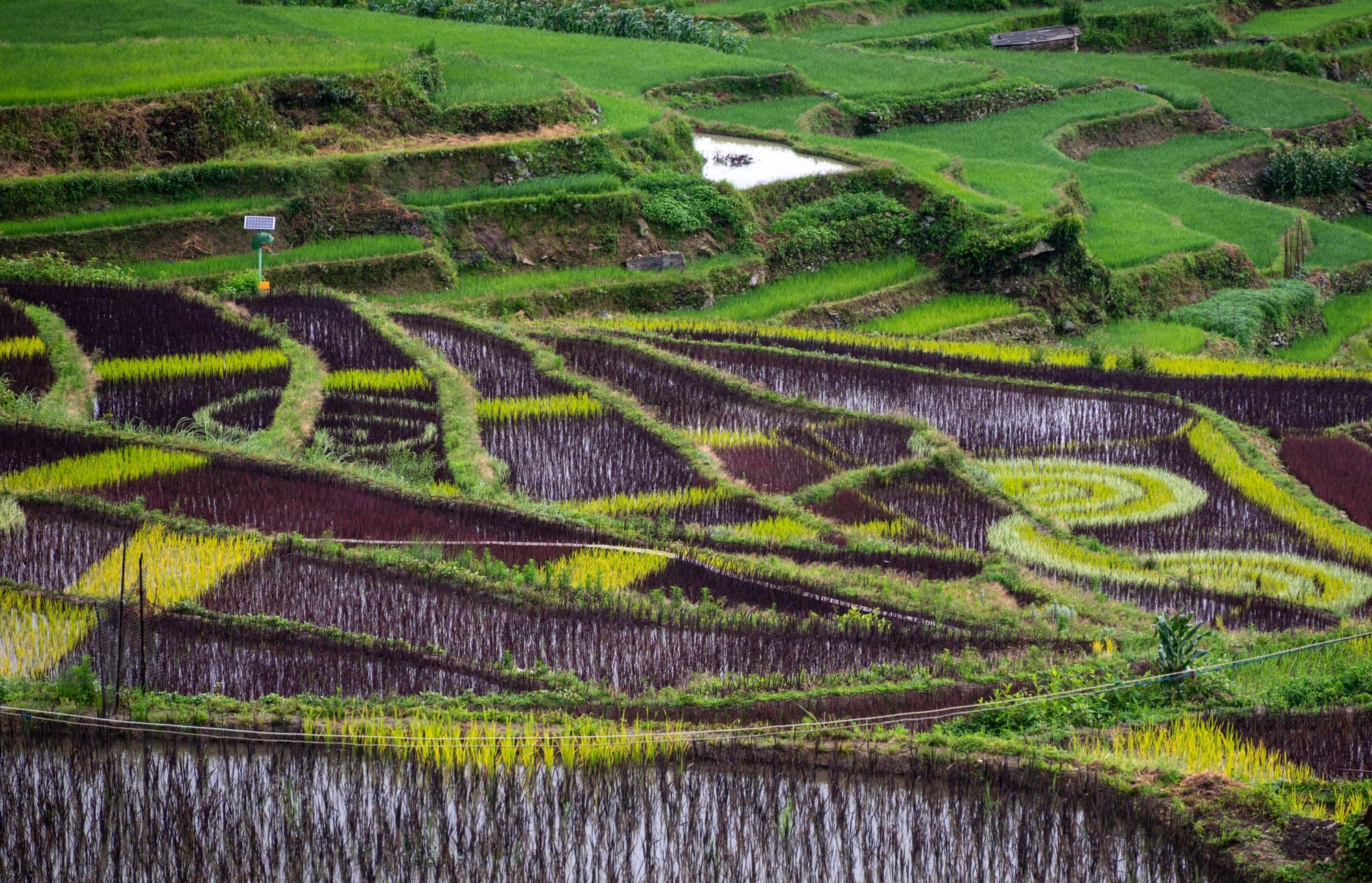
Photo by Xiquinho Silva. Licensed under CC BY 2.0. Honghe Hani Rice Terraces, Yuanyang County; cropped and resized for web.
A Short History of Rice, the Grain That Went Everywhere
USDA has this crop near 546 million tonnes, mostly long-grain indica, almost all milled white. The first fields were in China. West Africa grew a rice of its own.
September 23, 2026
The Hani terraces at Yuanyang, in Yunnan, still hold water the old way. Purple and green seedlings sit in the same shallow ponds, cut into the hill.
USDA puts the 2025/26 harvest at about 546 million tonnes, milled. India grew some 154 million of that, China 146, more than half the world between them. Most of that grain is eaten where it was grown. Only about 60 million tonnes cross a border.
More than a third of the planet eats rice every day. The sack in the cupboard came a long way.
The plant on most tables is Oryza sativa, taken from a wild grass, Oryza rufipogon. In 2024, researchers writing in Science read phytoliths, the silica traces plants leave in soil, from Shangshan and Hehuashan, two sites in the lower Yangtze. They dated wild gathering to about 24,000 years ago, cultivation to about 13,000, and domestication to about 11,000. Older digs had put domestication later.
A 2012 Nature map of rice genomes placed the first japonica, the shorter stickier grain, in southern China, with wild plants from the Pearl River in the mix. Indica, the long grain that now fills most tropical bowls, formed later when that crop met local wild rice in South and Southeast Asia. Researchers still argue the years. They keep starting in the wet fields of southern China, with a plant that stopped shattering before the harvest.
West Africa grew a different rice, Oryza glaberrima, from the wild grass Oryza barthii. One genomic study put a cradle in Mali’s Inner Niger Delta. Later papers made the map wider than one delta. Portuguese ships bought that grain on the Upper Guinea coast. Enslaved rice growers carried the skill, and sometimes the seed, to Brazil and the Carolinas. Asian sativa later took most of those fields.
Japonica moved through East Asia and, in 1468, shows up in the wetlands near Pisa, the first documented Italian crop. Spain already knew the plant from older Mediterranean routes. Long-grain indica filled the tropics. In the 1960s, short-straw Green Revolution plants raised yields on irrigated land, which is most of the rice the world now eats.
The International Rice Research Institute, the public genebank in Los Baños in the Philippines, keeps more than 127,000 samples, most of them sativa. A kitchen uses a handful of market types.
Indica is the bulk of the harvest. Japonica is maybe 13 to 15 percent, the everyday grain in Japan, Korea, and northern China, plus the risotto rice of the Po. Thai jasmine and Himalayan basmati take a rising share of exports. Glutinous rice stays a sticky specialty in mainland Southeast Asia. FAO still prices indica as the main class that crosses borders. Japonica barely trades. Those countries eat their own.
Brown rice still has its bran. The bran holds oil, and once the husk is off the oil turns. White rice is the same seed with that layer milled away. It cooks faster and keeps longer in a warehouse.
Cities wanted it first. In Edo Japan, and later in Meiji factory and army canteens, polished rice was urban food. Village tables still mixed in barley. Industrial mills and rising pay made white the everyday grain. Eaten with almost nothing else, that polish produced beriberi in barracks and on plantations, because the bran had held the thiamine. Households that ate vegetables and fish with the rice rarely saw that disease. Most shops still sell the grain milled.
East Asia is in harvest this week. In Korea the new crop goes on the Chuseok table, the harvest holiday that falls Friday. It is the same species as a jasmine sack in Bangkok. Most bowls still come from that short list.